
|
You entered: color
 APOD: 2024 October 29 Б NGC 602: Stars Versus Pillars from Webb
29.10.2024
The stars are destroying the pillars. More specifically, some of the newly formed stars in the image center are emitting light so energetic that is evaporating the gas and dust in the surrounding pillars. Simultaneously, the pillars themselves are still trying to form new stars.
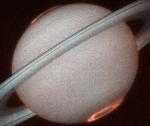 Saturnian Aurora
23.12.2001
the second largest planet in the Solar System, Saturn's Rings are one of the most spectacular sights for earthbound telescopes. This image from the orbiting Hubble Space Telescope's STIS instrument, offers a striking view of another kind of ring around Saturn - pole encircling rings of ultraviolet aurora.
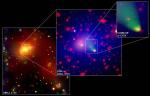 C153 Takes the Plunge
6.09.2004
A comet-like tail of glowing gas, 200,000 light-years long, streams from galaxy C153 as it plunges through galaxy cluster Abell 2125 at nearly 8 million kilometers per hour. Itself a member of the giant cluster of galaxies, C153 may once have been a spiral galaxy like the Milky Way.
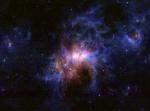 Dusty Environs of Eta Carinae
15.10.2005
Eta Car is a massive star, but it's not as bright as it used to be. Now only easily visible in binoculars or a small telescope, Eta Carinae has a history of spectacular flaring and fading behavior.
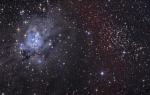 NGC 7129 and NGC 7142
13.09.2007
This alluring telescopic image looks toward the constellation Cepheus and an intriguing visual pairing of dusty reflection nebula NGC 7129 (left) and open star cluster NGC 7142. The two appear separated by only half a degree on the sky, but they actually lie at quite different distances.
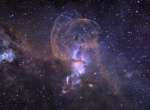 The NGC 3576 Nebula
26.03.2008
An intriguing and beautiful nebula, NGC 3576 drifts through the Sagittarius arm of our spiral Milky Way Galaxy. Within the region, episodes of star formation are thought to contribute to the complex and suggestive shapes. Powerful winds from the nebula's embedded, young, massive stars shape the looping filaments.
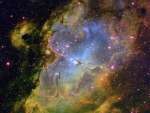 Inside the Eagle Nebula
8.02.2009
From afar, the whole thing looks like an Eagle. A closer look at the Eagle Nebula, however, shows the bright region is actually a window into the center of a larger dark shell of dust. Through this window, a brightly-lit workshop appears where a whole open cluster of stars is being formed.
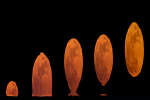 An Etruscan Vase Moon Rising
23.02.2009
What's happened to the Moon? Nothing, although from some locations, February's full moon, which occurred about two weeks ago, appeared strangely distorted as it rose. Visible in particular was a curiously inverted...
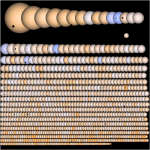 Kepler s Suns and Planets
29.03.2011
Using the prolific planet hunting Kepler spacecraft, astronomers have discovered 1,235 candidate planets orbiting other suns since the Kepler mission's search for Earth-like worlds began in 2009. To find them, Kepler monitors...
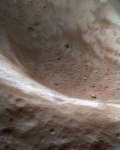 The Regolith of Asteroid Eros
19.06.2011
From fifty kilometers above asteroid Eros, the surface inside one of its largest craters appears covered with an unusual substance: regolith. The thickness and composition of the surface dust that is regolith remains a topic of much research.
|
January February March April May June July August September October |
|||||||||||||||||||||||||||||||||||||||||||||||||