
|
You entered: gas
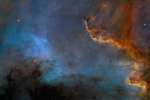 Along the Cygnus Wall
3.07.2014
The prominent ridge of emission featured in this vivid skyscape is known as the Cygnus Wall. Part of a larger emission nebula with a distinctive shape popularly called The North America Nebula, the ridge spans about 10 light-years along an outline that suggests the western coast of Mexico.
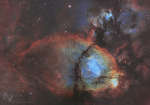 IC 1795: The Fishhead Nebula
23.12.2014
To some, this nebula looks like the head of a fish. However, this colorful cosmic portrait really features glowing gas and obscuring dust clouds in IC 1795, a star forming region in the northern constellation Cassiopeia.
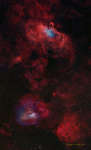 The Eagle and The Swan
23.08.2017
The Eagle Nebula and the Swan Nebula span this broad starscape, a telescopic view toward the Sagittarius spiral arm and the center of our Milky Way galaxy. The Eagle, also known as M16, is at top and M17, the Swan, at bottom of the frame showing the cosmic clouds as brighter regions of active star-formation.
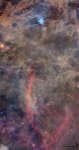 From the Pleiades to the Eridanus Loop
22.03.2020
If you stare at an interesting patch of sky long enough, will it look different? In the case of Pleiades and Hyades star clusters -- and surrounding regions -- the answer is: yes, pretty different. Long...
 Magnetic Streamlines of the Milky Way
16.06.2020
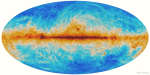
What role do magnetic fields play in interstellar physics? Analyses of observations by ESA's Planck satellite of emission by small magnetically-aligned dust grains reveal previously unknown magnetic field structures in our Milky Way Galaxy -- as shown by the curvy lines in the featured full-sky image.
 Cygnus: Bubble and Crescent
16.10.2020
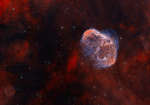
These clouds of gas and dust drift through rich star fields along the plane of our Milky Way Galaxy toward the high flying constellation Cygnus. Caught within the telescopic field of view are the Soap Bubble (lower left) and the Crescent Nebula (upper right).
 Half Sun with Prominence
1.11.2020
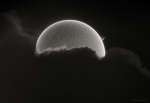
What's happening to the Sun? Clearly, the Sun's lower half is hidden behind a thick cloud. Averaging over the entire Earth, clouds block the Sun about 2/3rds of the time, although much less over many land locations. On the Sun's upper right is a prominence of magnetically levitating hot gas.
 North America and the Pelican
15.09.2021
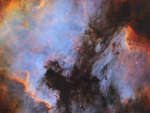
Fans of our fair planet might recognize the outlines of these cosmic clouds. On the left, bright emission outlined by dark, obscuring dust lanes seems to trace a continental shape, lending the popular name North America Nebula to the emission region cataloged as NGC 7000.
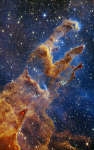 Pillars of Creation
19.10.2022
A now famous picture from the Hubble Space Telescope featured these star forming columns of cold gas and dust light-years long inside M16, the Eagle Nebula, dubbed the Pillars of Creation. This James Webb Space Telescope NIRCam image expands Hubble's exploration of that region in greater detail and depth inside the iconic stellar nursery.
 APOD: 2024 October 28 Б STEVE: A Glowing River over France
27.10.2024
Sometimes a river of hot gas flows over your head. In this case the river created a Strong Thermal Emission Velocity Enhancement (STEVE) that glowed bright red, white, and pink. Details of how STEVEs...
|
January February March April May June July August September October |
|||||||||||||||||||||||||||||||||||||||||||||||||