
|
You entered: gas
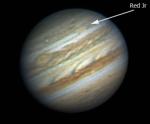 Red Spot Jr
18.03.2006
Jupiter's Great Red Spot, is a swirling storm seen for over 300 years, since the begining of telescopic observations of the Solar System's ruling gas giant. But over the last month it has been joined by Red Spot Jr.
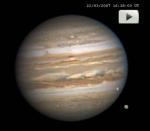 Jupiter Moon Movie
29.03.2007
South is toward the top in this frame from a stunning movie featuring Jupiter and moons recorded last Thursday from the Central Coast of New South Wales, Australia. In fact, three jovian moons and two red spots are ultimately seen in the full video as they glide around the solar system's ruling gas giant.
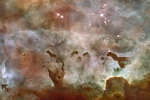 Dark Clouds of the Carina Nebula
28.05.2008
What dark forms lurk in the mists of the Carina Nebula? These ominous figures are actually molecular clouds, knots of molecular gas and dust so thick they have become opaque. In comparison, however, these clouds are typically much less dense than Earth's atmosphere.
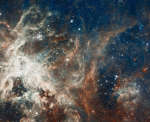 Star Formation in the Tarantula Nebula
16.05.2012
The largest, most violent star forming region known in the whole Local Group of galaxies lies in our neighboring galaxy the Large Magellanic Cloud (LMC). Were the Tarantula Nebula at the distance of the Orion Nebula -- a local star forming region -- it would take up fully half the sky.
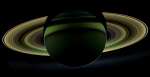 Saturn at Night
22.12.2012
Splendors seldom seen are revealed in this glorious picture from Saturn's shadow. Imaged by Cassini on October 17, 2012 during its 174th orbit, the ringed planet's night side is viewed from...
 Dry Ice Sled Streaks on Mars
17.06.2013
What creates these long and nearly straight grooves on Mars? Dubbed linear gullies, they appear on the sides of some sandy slopes during Martian spring, have nearly constant width, extend for as long as two kilometers, and have raised banks along their sides.
 Massive Nearby Spiral Galaxy NGC 2841
21.04.2014
It is one of the more massive galaxies known. A mere 46 million light-years distant, spiral galaxy NGC 2841 can be found in the northern constellation of Ursa Major. This sharp view of the gorgeous island universe shows off a striking yellow nucleus and galactic disk.
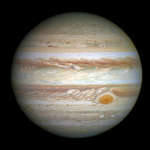 Hubble s Jupiter and Shrinking Great Red Spot
17.05.2014
Gas giant Jupiter is the solar system's largest world with about 320 times the mass of planet Earth. It's also known for a giant swirling storm system, the Great Red Spot, featured in this sharp Hubble image from April 21.
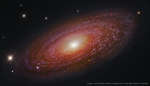 Massive Nearby Spiral Galaxy NGC 2841
28.04.2015
It is one of the more massive galaxies known. A mere 46 million light-years distant, spiral galaxy NGC 2841 can be found in the northern constellation of Ursa Major. This sharp view of the gorgeous island universe shows off a striking yellow nucleus and galactic disk.
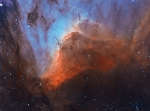 Pelican Nebula Close Up
3.08.2017
The prominent ridge of emission featured in this vivid skyscape is designated IC 5067. Part of a larger emission region with a distinctive shape, popularly called The Pelican Nebula, the ridge spans about 10 light-years and follows the curve of the cosmic pelican's head and neck.
|
January February March April May June July August September October |
|||||||||||||||||||||||||||||||||||||||||||||||||