
|
You entered: gas
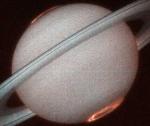 Saturnian Aurora
17.09.2000
Girdling the second largest planet in the Solar System, Saturn's Rings are one of the most spectacular sights for earthbound telescopes. This image from the orbiting Hubble Space Telescope's STIS instrument, offers a striking view of another kind of ring around Saturn - pole encircling rings of ultraviolet aurora.
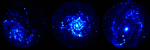 A Spiral Galaxy Gallery
9.04.1996
A progression of beautiful spiral galaxies is illustrated above with three photographs from NASA's Ultraviolet Imaging Telescope (UIT). Flying above the Earth's obscuring layer of atmosphere on the Space Shuttle Columbia during...
 A Quasar Portrait Gallery
25.11.1996
QUASARs (QUASi-stellAR objects) lie near the edge of the observable Universe. Discovered in 1963, astronomers were astounded - to be visible at such extreme distances of billions of light-years they must emit prodigious amounts of energy. Where does the energy come from?
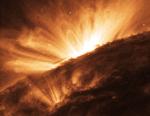 TRACE and the Active Sun
15.05.1998
This dramatic high resolution picture looking across the edge of the Sun was taken April 24th by a telescope on board the newly launched Transition Region and Coronal Explorer (TRACE) satellite. It shows graceful arcs of intensely hot gas suspended in powerful looping magnetic fields which soar above a solar active region.
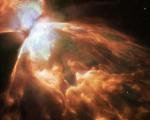 NGC 6302: Big Bright Bug Nebula
5.05.2004
The bright clusters and nebulae of planet Earth's night sky are often named for flowers or insects, and NGC 6302 is no exception. With an estimated surface temperature of about 250,000 degrees...
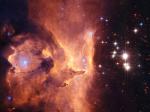 Massive Stars in Open Cluster Pismis 24
19.12.2006
How massive can a normal star be? Estimates made from distance, brightness and standard solar models had given one star in the open cluster Pismis 24 over 200 times the mass of our Sun, making it a record holder.
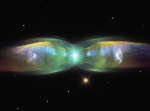 M2 9: Wings of a Butterfly Nebula
15.09.2013
Are stars better appreciated for their art after they die? Actually, stars usually create their most artistic displays as they die. In the case of low-mass stars like our Sun and M2-9 pictured above, the stars transform themselves from normal stars to white dwarfs by casting off their outer gaseous envelopes.
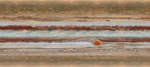 Jupiter in 2015
24.10.2015
Two remarkable global maps of Jupiter's banded cloud tops can be compared by just sliding your cursor over this sharp projection (or follow this link) of image data from the Hubble Space Telescope.
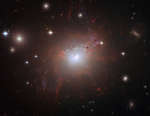 Active Galaxy NGC 1275
26.01.2023
Active galaxy NGC 1275 is the central, dominant member of the large and relatively nearby Perseus Cluster of Galaxies. Wild-looking at visible wavelengths, the active galaxy is also a prodigious source of x-rays and radio emission.
 APOD: 2025 January 26 Б The Many Tails of Comet G3 ATLAS
26.01.2025
Why does this comet have so many tails? C/2024 G3 (ATLAS) has developed several long and intricate tails visible from Earth's southern hemisphere over the past two weeks. Many observers reported seeing the impressive comet without any optical aid above the western horizon just after sunset.
|
January February March April May June July August September October |
|||||||||||||||||||||||||||||||||||||||||||||||||