
|
You entered: planets
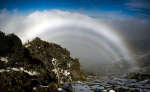 A Hall of Mountain Glory
4.05.2010
If you tried to enter this hall of fog, you would find it dissipates around you. The hall is actually an the mountain from which this picture was taken. Known as "the glory", the phenomenon is frequently seen from airplanes.
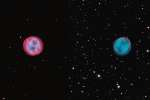 Northern and Southern Owls
6.05.2010
Captured in colorful telescopic portraits, two cosmic owls glare back toward planet Earth in this intriguing comparison of planetary nebulae. On the left is M97 in the constellation Ursa Major, also known in the northern hemisphere as the Owl Nebula.
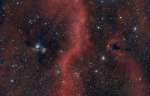 Decorating the Sky
25.12.2010
Bright stars, clouds of dust and glowing nebulae decorate this cosmic scene, a skyscape just north of Orion's belt. Close to the plane of our Milky Way Galaxy, the wide field view spans about 5.5 degrees. Striking bluish M78, a reflection nebula, is at the left.
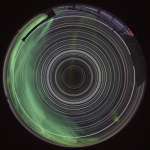 South Pole Star Trails
2.08.2012
No star dips below the horizon and the Sun never climbs above it in this remarkable Lewin's Challenge image of 24 hour long star trails. Showing all the trails as complete circles, such an image could be achieved only from two places on planet Earth.
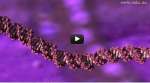 DNA: The Molecule that Defines You
21.08.2012
Every living thing on planet Earth is defined by its own molecule -- what's yours? This molecule, called DNA, spans about two meters stretched out but is coiled into every cell in your body.
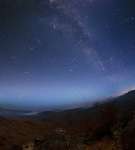 Lyrids in Southern Skies
24.04.2014
Earth's annual Lyrid meteor shower peaked before dawn on April 22nd, as our fair planet plowed through dust from the tail of long-period comet Thatcher. Even in the dry and dark Atacama desert along Chile's Pacific coast, light from a last quarter Moon made the night sky bright, washing out fainter meteor streaks.
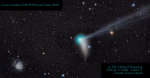 The View Toward M101
21.01.2016
Sweeping through northern skies, Comet Catalina (C/2013 US10) made its closest approach on January 17, passing about 6 light-minutes from our fair planet. Dust and ion tails clearly separated in this Earth-based view, the comet is also posed for a Messier moment, near the line-of-sight to M101, grand spiral galaxy in Ursa Major.
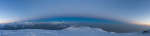 Earth Shadow over Damavand
14.04.2017
Through crystal clear skies this beautiful panorama follows the curve of planet Earth's shadow rising across the top of the world. The tantalizing twilight view is composed of eight single frames captured from 4,000 meters above sea level at sunset on April 6.
 The Galaxy Above
15.10.2019
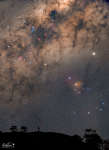
Have you contemplated your home galaxy lately? If your sky looked like this, perhaps you'd contemplate it more often! The featured picture is actually a composite of two images taken last month from the same location in south Brazil and with the same camera -- but a few hours apart.
 Milky Way over the Pinnacles in Australia
11.10.2020
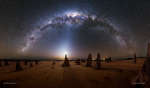
What strange world is this? Earth. In the foreground of the featured image are the Pinnacles, unusual rock spires in Nambung National Park in Western Australia. Made of ancient sea shells (limestone), how these human-sized picturesque spires formed remains unknown.
|
January February March April May June July August September October |
|||||||||||||||||||||||||||||||||||||||||||||||||