
|
You entered: planets
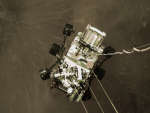 Perseverance: How to Land on Mars
20.02.2021
Slung beneath its rocket powered descent stage Perseverance hangs only a few meters above the martian surface, captured here moments before its February 18 touchdown on the Red Planet. The breath-taking view followed an intense seven minute trip from the top of the martian atmosphere.
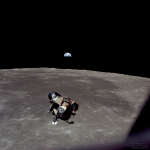 Apollo 11: Earth, Moon, Spaceship
3.05.2021
After the most famous voyage of modern times, it was time to go home. After proving that humanity has the ability to go beyond the confines of planet Earth, the first humans to walk...
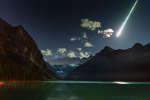 Fireball over Lake Louise
12.10.2021
What makes a meteor a fireball? First of all, everyone agrees that a fireball is an exceptionally bright meteor. Past that, the International Astronomical Union defines a fireball as a meteor brighter than apparent magnitude -4, which corresponds (roughly) to being brighter than any planet -- as well as bright enough to cast a human-noticeable shadow.
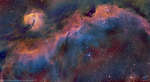 The Seagull Nebula
19.01.2023
A broad expanse of glowing gas and dust presents a bird-like visage to astronomers from planet Earth, suggesting its popular moniker - The Seagull Nebula. Using narrowband image data, this 3-panel mosaic of the cosmic...
 The Large Cloud of Magellan
7.09.2023
The 16th century Portuguese navigator Ferdinand Magellan and his crew had plenty of time to study the southern sky during the first circumnavigation of planet Earth. As a result, two fuzzy cloud-like objects easily...
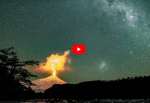 APOD: 2024 July 17 Б Villarrica Volcano Against the Sky
17.07.2024
When Vulcan, the Roman god of fire, swings his blacksmith's hammer, the sky is lit on fire. A recent eruption of Chile's Villarrica volcano shows the delicate interplay between this fire -- actually...
 Periodic Comet Swift Tuttle
8.08.2024
A Halley-type comet with an orbital period of about 133 years, Comet 109P/Swift-Tuttle is recognized as the parent of the annual Perseid Meteor Shower. The comet's last visit to the inner Solar System was in 1992.
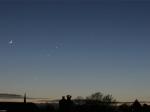 Mercury Over Leeds
7.03.2005
Have you ever seen the planet Mercury? This week might be a good time. Because Mercury orbits so close to the Sun, it never wanders far from the Sun in Earth's sky. If trailing the Sun, Mercury will be visible low on the horizon for only a short while after sunset.
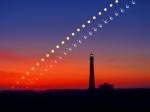 Solar System Rising Over Fire Island
3.05.2005
If you wait long enough, the entire Solar System will rise before you. To see such a sight, however, you will need to look in the direction of the ecliptic. All of the planets and their moons orbit the Sun in nearly the same plane, the ecliptic plane.
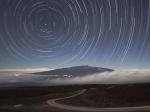 Star Trails Above Mauna Kea
20.12.2005
Is there a road to the stars? Possibly there are many, but the physical road pictured above leads up to the top of a dormant volcano that is a premier spot on planet Earth for observing stars and astronomical phenomena.
|
January February March April May June July August September October |
|||||||||||||||||||||||||||||||||||||||||||||||||