
|
You entered: planets
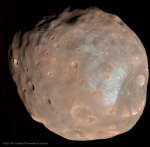 Phobos: Doomed Moon of Mars
3.07.2022
This moon is doomed. Mars, the red planet named for the Roman god of war, has two tiny moons, Phobos and Deimos, whose names are derived from the Greek for Fear and Panic. These...
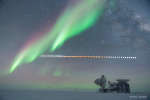 Lunar Eclipse at the South Pole
5.11.2022
Last May 16 the Moon slid through Earth's shadow, completely immersed in the planet's dark umbra for about 1 hour and 25 minutes during a total lunar eclipse. In this composited timelapse...
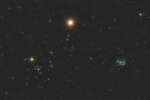 Mars and the Star Clusters
30.12.2022
At this year's end Mars still shines brightly in planet Earth's night as it wanders through the head-strong constellation Taurus. Its bright yellowish hue dominates this starry field of view that includes Taurus' alpha star Aldebaran and the Hyades and Pleiades star clusters.
 APOD: 2025 June 19 Б NGC 3521: Galaxy in a Bubble
19.06.2025
Gorgeous spiral galaxy NGC 3521 is a mere 35 million light-years away, toward the northern springtime constellation Leo. Relatively bright in planet Earth's sky, NGC 3521 is easily visible in small telescopes but often overlooked by amateur imagers in favor of other Leo spiral galaxies, like M66 and M65.
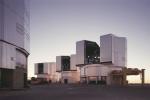 Sirius, Sun, Moon, and Southern Cross
7.07.2000
From left to right are the enclosures of Yepun (ye-poon; Sirius), Antu (an-too; Sun), Kueyen (qua-yen; Moon), and Melipal (me-li-pal; Southern Cross), pictured here as night falls at Paranal Observatory in northern Chile. These are the four 8.2 meter wide telescope units of the European Southern Observatory's Very Large Telescope (VLT).
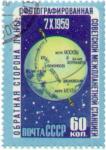 The Averted Side Of The Moon
9.10.2004
This vintage 60-kopek stamp celebrates a dramatic achievement. On the 7th of October, 1959 (7/X/1959), the Soviet interplanetary station which has come to be called "Luna 3" successfully photographed the far side of the moon giving denizens of planet Earth their first ever view of this hidden hemisphere.
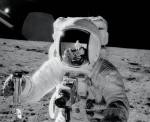 Apollo 12: Self-Portrait
21.01.2006
In November of 1969, Apollo 12 astronaut-photographer Charles "Pete" Conrad recorded this masterpiece while documenting colleague Alan Bean's lunar soil collection activities on the Oceanus Procellarum. The image is dramatic and stark.
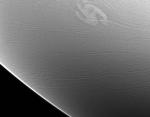 Saturn Storm by Ringshine
23.02.2006
Imaged on the night side of Saturn by the Cassini spacecraft, these swirling storm clouds are illuminated by ringshine - sunlight reflected from the gas giant's magnificent ring system. The storm (top) was actually spotted last month by amateur astronomers as it rotated across Saturn's day side and spans about 3,500 kilometers.
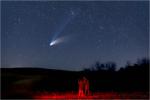 Hale Bopp: The Great Comet of 1997
31.03.2007
Ten short years ago, Comet Hale-Bopp rounded the Sun and offered a dazzling spectacle in planet Earth's night. This stunning view, recorded shortly after the comet's perihelion passage on April 1, 1997, features the memorable tails of Hale-Bopp -- a whitish dust tail and blue ion tail.
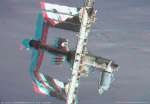 Stereo Space Station
23.02.2008
Get out your red-blue glasses and float next to the International Space Station (ISS), planet Earth's largest artificial moon. This fun stereo view was constructed from parts of two separate images (S122-E-009880, S122-E-009893) and an additional background recorded as the shuttle orbiter Atlantis undocked from the ISS on February 18.
|
January February March April May June July August September October |
|||||||||||||||||||||||||||||||||||||||||||||||||