
|
You entered: planets
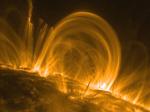 Heating Coronal Loops
14.08.2005
Why is the corona of the Sun so hot? Extending above the photosphere or visible surface of the Sun, the faint, tenuous solar corona can't be easily seen from Earth, but it is measured to be hundreds of times hotter than the photosphere itself.
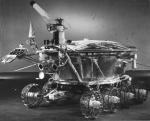 Lunokhod: Moon Robot
13.01.2006
On November 17, 1970 the Soviet Luna 17 spacecraft landed the first roving remote-controlled robot on the Moon. Known as Lunokhod 1, it weighed just under 2,000 pounds and was designed to operate...
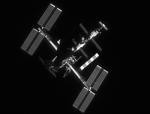 A Visit from Atlantis
28.06.2007
This remarkable image of the space shuttle orbiter Atlantis docked with the International Space Station (ISS) was taken at a range of 190 nautical miles. To record the fast moving pair, last week astronomers...
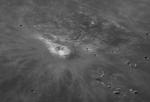 Aristarchus Plateau
29.11.2007
Anchored in the vast lava flows of the Moon's Oceanus Procellarum lies the Aristarchus Plateau. The bright impact crater at the corner of the plateau is Aristarchus, a young crater 42 kilometers wide and 3 kilometers deep. Only slightly smaller, lava flooded Herodotus crater is above and to the left.
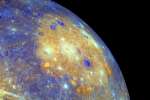 Enhanced Color Caloris
10.07.2008
The sprawling Caloris basin on Mercury is one of the solar system's largest impact basins. Created during the early history of the solar system by the impact of a large asteroid-sized body, the basin spans about 1,500 kilometers and is seen in yellowish hues in this enhanced color mosaic.
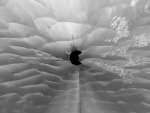 Martian Dunes and the Shadow of Opportunity
23.03.2009
Human made robots continue to roll across the surface of Mars. Both Opportunity and its sister rover Spirit are in their sixth year on Mars, exploring the red planet for years longer than original expectations.
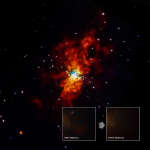 No X rays from SN 2014J
16.08.2014
Last January, telescopes in observatories around planet Earth were eagerly used to watch the rise of SN 2014J, a bright supernova in nearby galaxy M82. Still, the most important observations may have been from orbit where the Chandra X-ray Observatory saw nothing.
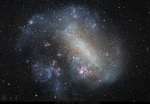 The Large Cloud of Magellan
26.08.2015
The 16th century Portuguese navigator Ferdinand Magellan and his crew had plenty of time to study the southern sky during the first circumnavigation of planet Earth. As a result, two fuzzy cloud-like objects easily...
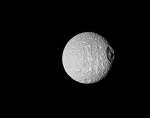 Mimas, Crater, and Mountain
10.01.2017
Mimas is an icy, crater-pocked moon of Saturn a mere 400 kilometers (250 miles) in diameter. Its largest crater Herschel is nearly 140 kilometers wide. About a third the diameter of Mimas itself, Herschel crater gives the small moon an ominous appearance, especially for scifi fans of the Death Star battlestation of Star Wars fame.
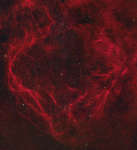 RCW 114: A Dragon s Heart in Ara
10.01.2018
Large and dramatically shaped, this cosmic cloud spans nearly 7 degrees or 14 full moons across planet Earth's sky toward the southern constellation Ara. Difficult to image, the filamentary apparition is cataloged as RCW 114 and traced in this telescopic mosaic by the telltale reddish emission of ionized hydrogen atoms.
|
January February March April May June July August September October |
|||||||||||||||||||||||||||||||||||||||||||||||||