
|
You entered: planets
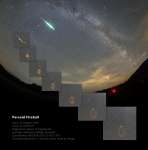 Perseid Fireball and Persistent Train
17.08.2018
Before local midnight on August 12, this brilliant Perseid meteor flashed above the Poloniny Dark Sky Park, Slovakia, planet Earth. Streaking beside the summer Milky Way, its initial color is likely due to the shower meteor's characteristically high speed.
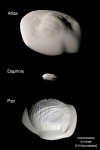 Atlas, Daphnis, and Pan
18.05.2019
Atlas, Daphnis, and Pan are small, inner, ring moons of Saturn. They are shown at the same scale in this montage of images by the Cassini spacecraft that made its grand final orbit of the ringed planet in September 2017. In fact, Daphnis was discovered in Cassini images from 2005.
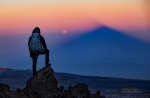 Moonrise and Mountain Shadow
14.03.2020
What phase of the Moon is 3.14 radians from the Sun? The Full Moon, of course. Even though the Moon might look full for several days, the Moon is truly at its full phase when it is 3.14 radians (aka 180 degrees) from the Sun in ecliptic longitude.
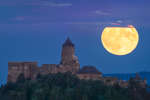 Lubovna Full Moon
15.07.2022
On July 13 this well-planned telephoto view recorded a Full Moon rising over Lubovna Castle in eastern Slovakia. The photographer was about 3 kilometers from the castle walls and about 357,000 kilometers from this Full Moon near perigee, the closest point in its elliptical orbit.
 APOD: 2025 February 2 Б Comet G3 ATLAS Disintegrates
2.02.2025
What's happening to Comet G3 ATLAS? After passing near the Sun in mid-January, the head of the comet has become dimmer and dimmer. By late January, Comet C/2024 G3 (ATLAS) had become a headless wonder -- even though it continued to show impressive tails after sunset in the skies of Earth's Southern Hemisphere.
 The Horsehead Nebula
10.12.2025
Sculpted by stellar winds and radiation, this dusty interstellar molecular cloud has by chance has assumed an immediately recognizable shape. Fittingly known as The Horsehead Nebula, it lies some 1,500 light-years distant, embedded in the vast Orion cloud complex.
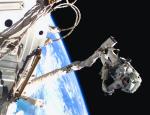 Astronaut at Work
31.05.2000
Did you ever have a day where everything got turned around and you just couldn't tell which way was up? Fortunately, this didn't happen to astronaut James S. Voss on May 21, who spent six hours preparing to fix and upgrade the International Space Station.
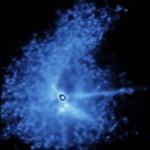 The T Tauri Star Forming System
4.06.2001
What did the Sun look like before there were planets? A prototype laboratory for the formation of low mass stars like our Sun is the T Tauri system, one of the brighter star systems toward the constellation of Taurus. In young systems, gravity causes a gas cloud to condense.
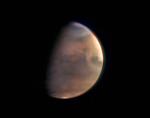 Express to Mars
18.12.2003
Hurtling toward its destination, the high resolution camera on board ESA's Mars Express spacecraft recorded this tantalizing view of the Red Planet earlier this month on December 3rd. Seen from a distance of 5.5 million kilometers, features across part of Mars' western hemisphere are bathed in sunlight.
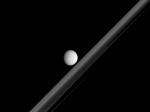 Saturnian Moon and Rings
18.04.2005
When can a robot produce art? When it glides past the rings of Saturn, for one. As the robot spacecraft Cassini orbiting Saturn crossed outside the famous photogenic ring plane of the expansive planet, the rings were imaged from the outside, nearly edge on, and in the shadow of Saturn.
|
January February March April May June July August September October |
|||||||||||||||||||||||||||||||||||||||||||||||||