
|
You entered: planets
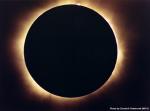 Sun Block
18.08.1999
During a total solar eclipse, Earth's moon blocks the sun - almost exactly. While the sun is about 400 times wider than the moon, it is also about 400 times farther away and each appears to be half a degree or so in diameter.
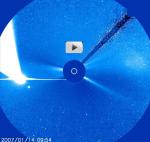 SOHO: Comet McNaught Movie
20.01.2007
This frame from a spectacular time lapse movie shows Comet McNaught - the Great Comet of 2007 - sweeping through the inner solar system. The movie frames were recorded from January 12 through Jan 16 by a coronograph onboard the sun-staring SOHO spacecraft.
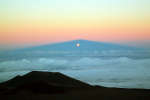 Moonrise Through Mauna Keas Shadow
5.12.2010
How can the Moon rise through a mountain? It cannot -- what was photographed here is a moonrise through the shadow of a large volcano. The volcano is Mauna Kea, Hawai'i, USA, a frequent spot for spectacular photographs since it is arguably the premier observing location on planet Earth.
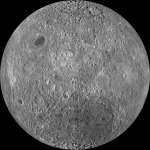 Lunar Farside
9.04.2011
Tidally locked in synchronous rotation, the Moon always presents its familiar nearside to denizens of planet Earth. From lunar orbit, the Moon's farside can become familiar, though. In fact this sharp picture, a mosaic from the Lunar Reconnaissance Orbiter's wide angle camera, is centered on the lunar farside.
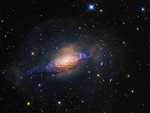 NGC 3521: Galaxy in a Bubble
15.09.2011
Gorgeous spiral galaxy NGC 3521 is a mere 35 million light-years away, toward the constellation Leo. Relatively bright in planet Earth's sky, NGC 3521 is easily visible in small telescopes but often overlooked by amateur imagers in favor of other Leo spiral galaxies, like M66 and M65.
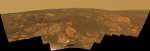 Matijevic Hill Panorama
25.01.2013
On January 25 (UT) 2004, the Opportunity rover fell to Mars, making today the 9th anniversary of its landing. After more than 3,200 sols (Mars solar days) the golf cart-sized robot from Earth is still actively exploring the Red Planet, though its original mission plan was for three months.
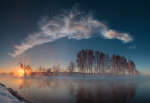 Miass River Sunrise
2.03.2013
Each day on planet Earth can have a serene beginning at sunrise as the sky gently grows bright over a golden eastern horizon. This sunrise panorama seems to show such a moment on the winter morning of February 15.
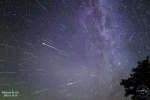 Perseid Meteors Over China
21.08.2013
Comet dust rained down on planet Earth earlier this month, streaking through dark skies in the annual Perseid meteor shower. While enjoying the anticipated space weather above Zhangbei Prairie, Hebei Province, China, astronomer Xiang...
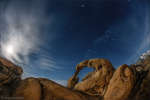 Mobius Arch Moonrise
28.02.2014
Only two days past full, February's moon shines through thin clouds, rising on the left in this fisheye night skyscape. The moonlight illuminates a weathered, rounded foreground in the Alabama Hills, conveniently located east of Mt. Whitney along the Sierra Nevada range in California, USA, planet Earth.
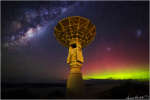 Satellite Station and Southern Skies
31.05.2014
This clear night skyscape captures the colorful glow of aurora australis, the southern lights, just outside the port city of Hobart, Tasmania, Australia, planet Earth. As if staring into the dreamlike scene, the Tasmanian Earth Resources Satellite Station poses in the center, illuminated by nearby city lights.
|
January February March April May June July August September October |
|||||||||||||||||||||||||||||||||||||||||||||||||