
|
You entered: Sun
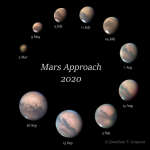 Mars Approach 2020
6.10.2020
Look to the east just after sunset tonight and you'll see a most impressive Mars. Tonight, Mars will appear its biggest and brightest of the year, as Earth passes closer to the red planet than it has in over two years -- and will be again for another two years.
 Millions of Stars in Omega Centauri
28.03.2024
Globular star cluster Omega Centauri, also known as NGC 5139, is 15,000 light-years away. The cluster is packed with about 10 million stars much older than the Sun within a volume about 150 light-years in diameter.
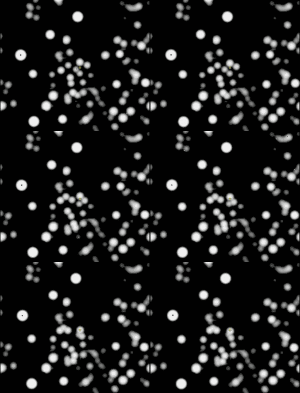 Sgr A: Fast Stars Near the Galactic Center
20.12.2000
Why are these stars moving so fast? Shown above is a time-lapse movie in infrared light detailing how stars in the central light-year of our Galaxy have moved over the past eight years. The yellow mark at the image center represents the location of a peculiar radio source named Sgr A
 Leonids from Leo
17.11.2002
Is Leo leaking? Leo, the famous sky constellation visible on the left of the above all-sky photograph, appears to be the source of all the meteors seen in last year's Leonids Meteor Shower.
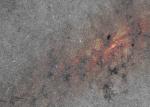 The Galactic Center in Infrared
7.09.2003
The center of our Galaxy is a busy place. In visible light, much of the Galactic Center is obscured by opaque dust. In infrared light, however, dust glows more and obscures less, allowing nearly one million stars to be recorded in the above photograph.
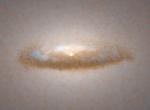 The Doomed Dust Disk of NGC 7052
22.06.1998
What created the dust disk in the center of NGC 7052, and what keeps it spinning? Although the disk might appear as a relatively tame "hubcap in space", the unusual center of elliptical galaxy NGC 7052 is probably the remnant of a titanic collision between galaxies.
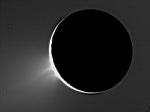 Ice Fountains Discovered on Saturns Enceladus
5.12.2005
Fountains of ice shoot out from Saturn's moon Enceladus. Clear discovery images of the fountains were made using observations from the robot Cassini spacecraft currently orbiting Saturn. During a recent pass, Cassini was programmed to look back toward the Sun where Enceladus would appear as a thin crescent.
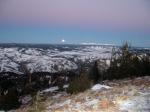 Shadow Set
4.02.2006
A nearly full Moon and planet Earth's shadow set together in this scene captured on January 13th from snowy Mt. Jelm, home of the Wyoming Infrared Observatory. For early morning risers (and late...
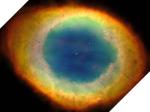 M57: The Ring Nebula
25.06.2006
It looked like a ring on the sky. Hundreds of years ago astronomers noticed a nebula with a most unusual shape. Now known as M57 or NGC 6720, the gas cloud became popularly known as the Ring Nebula.
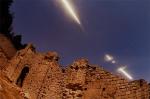 A Lunar Eclipse Over Time
26.01.2000
During last week's lunar eclipse, our Moon appeared to disappear. As the Earth moved between the Moon and the Sun, the Earth's shadow fell on the moon, making it quite dark. In the above photograph, the Earth's rotation caused the Moon and stars to appear as streaks during this four-hour exposure.
|
January February March April May June July August September October |
|||||||||||||||||||||||||||||||||||||||||||||||||