
|
You entered: Sun
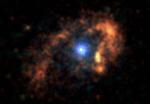 Eta Carinae in X Rays
11.10.1999
Eta Carinae is the one of the most luminous star systems in our Galaxy, radiating millions of times more power than our Sun. Eta Carinae is also one of the strangest star systems known, brightening and fading greatly since the early 1800s.
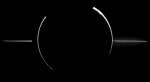 Jupiters Rings Revealed
6.01.2008
Why does Jupiter have rings? Jupiter's rings were discovered in 1979 by the passing Voyager 1 spacecraft, but their origin was a mystery. Data from the Galileo spacecraft that orbited Jupiter from 1995 to 2003 later confirmed that these rings were created by meteoroid impacts on small nearby moons.
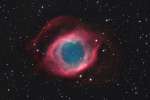 NGC 7293: The Helix Nebula
8.01.2011
A mere seven hundred light years from Earth, in the constellation Aquarius, a sun-like star is dying. Its last few thousand years have produced the Helix Nebula (NGC 7293), a well studied and nearby example of a Planetary Nebula, typical of this final phase of stellar evolution.
 Four Planet Sunset
13.06.2013
You can see four planets in this serene sunset image, created from a series of stacked digital exposures captured near dusk on May 25. The composite picture follows the trail of three of them...
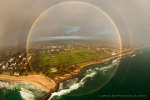 A Full Circle Rainbow over Australia
30.09.2014
Have you ever seen an entire rainbow? From the ground, typically, only the top portion of a rainbow is visible because directions toward the ground have fewer raindrops. From the air, though, the entire 360 degree circle of a rainbow is more commonly visible.
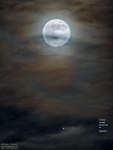 Moons and Jupiter
13.04.2017
On April 10, a Full Moon and Jupiter shared this telephoto field of view. Both were near opposition, opposite the Sun in Earth's night sky. Captured when a passing cloud bank dimmmed...
 Lunar Eclipse over Rio
30.07.2018
Moonrise doesn't usually look this interesting. For one thing, the full moon is not usually this dark -- but last Friday the moon rose here as it simultaneously passed through the shadow of the Earth.
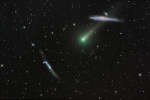 Comet Leonard and the Whale Galaxy
3.12.2021
Sweeping through northern predawn skies, on November 24 Comet Leonard (C/2021 A1) was caught between two galaxies in this composite telescopic image. Sporting a greenish coma the comet's dusty tail seems to harpoon the heart of NGC 4631 (top) also known as the Whale Galaxy.
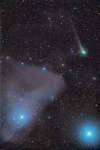 Stardust and Comet Tails
20.08.2022
Heading for its closest approach to the Sun, or perihelion, on December 19 comet C/2017 K2 (PanSTARRS) remains a sight for telescopic observers as it sweeps through planet Earth's skies in the constellation Scorpius.
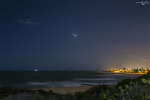 APOD: 2023 March 5 Б Jupiter and Venus over Italy
5.03.2023
What are those two bright spots? Planets. A few days ago, the two brightest planets in the night sky passed within a single degree of each other in what is termed a conjunction. Visible just after sunset in much of the world, the two bright spots were Jupiter (left) and Venus (right).
|
January February March April May June July August September October |
|||||||||||||||||||||||||||||||||||||||||||||||||