
|
You entered: Sun
 Fata Morgana: A Possibly Titanic Mirage
15.04.2012
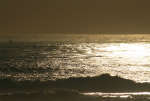
Did this mirage help sink the Titanic? The optical phenomenon called Fata Morgana can make strange shapes or a false wall of water appear above a watery horizon. When conditions are right, light reflecting...
 Earth at Twilight
6.04.2013
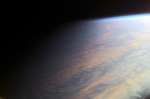
No sudden, sharp boundary marks the passage of day into night in this gorgeous view of ocean and clouds over our fair planet Earth. Instead, the shadow line or terminator is diffuse and shows the gradual transition to darkness we experience as twilight.
 Flowing Auroras Over Norway
9.06.2013
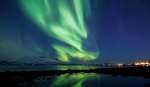
Have you ever seen an aurora? Auroras are occurring again with increasing frequency. With the Sun peaking at its eleven year maximum in aurora-triggering activity, it is exhibiting a greater abundance of sunspots, flares, and coronal mass ejections.
 A Super Moon s Halo
28.06.2013
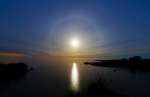
A Full Perigee Moon rose as the Sun set last Sunday. At its closest to Earth it was, by just a bit, the year's brightest and largest Full Moon also known as a Super Moon.
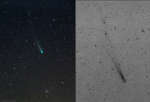 Active Comet ISON
16.11.2013
Falling through planet Earth's predawn skies toward its close encounter with the Sun on November 28, Comet ISON is coming to life. The much anticipated comet has now been reported to have substantially increased in brightness, surging to naked-eye visibility for dark sites and sprouting a more complex tail.
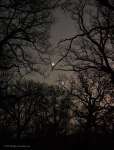 Mars Red and Spica Blue
2.04.2014
A bright pair of sky objects will be visible together during the next few months. Mars will shine brightly in its familiar rusty hue as it reaches its brightest of 2014 next week.
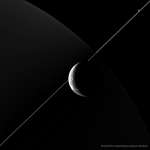 APOD: 2015 July 8 In the Company of Dione
8.07.2015
That is not our Moon. It's Dione, and its a moon of Saturn. The robotic Cassini spacecraft took the featured image during a flyby of Saturn's cratered Moon last month. Perhaps what makes this image so interesting, though, is the background.
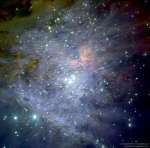 Magnetic Orion
27.02.2019
Can magnetism affect how stars form? Recent analysis of Orion data from the HAWC+ instrument on the airborne SOFIA observatory indicate that, at times, it can. HAWC+ is able to measure the polarization of far-infrared light which can reveal the alignment of dust grains by expansive ambient magnetic fields.
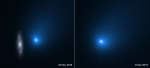 Interstellar Comet 2I Borisov
14.12.2019
From somewhere else in the Milky Way galaxy, Comet 2I/Borisov is just visiting the Solar System. Discovered by Crimean amateur astronomer Gennady Borisov on August 30, 2019, the first known interstellar comet is captured in these two recent Hubble Space Telescope images.
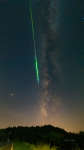 A Perseid Meteor and the Milky Way
3.08.2021
It was bright and green and flashed as it moved quickly along the Milky Way. It left a trail that took 30 minutes to dissipate. Given the day, August 12, and the direction, away...
|
January February March April May June July August September October |
|||||||||||||||||||||||||||||||||||||||||||||||||