
|
You entered: Sun
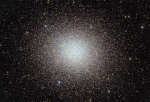 Millions of Stars in Omega Centauri
15.03.2023
Globular star cluster Omega Centauri, also known as NGC 5139, is 15,000 light-years away. The cluster is packed with about 10 million stars much older than the Sun within a volume about 150 light-years in diameter.
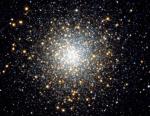 Hydrogen, Helium, and the Stars of M10
30.06.2001
Stars like the Sun use hydrogen for fuel, "burning" hydrogen into helium at their cores through nuclear fusion. But what happens when that hydrogen runs out? For a while, hydrogen burns in a shell surrounding the stellar core and the star expands to become a red giant.
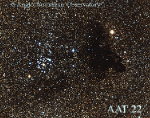 Bright Stars and Dark Clouds
25.09.1996
Did you ever feel like a black cloud was following you around? Well don't feel bad - this even happened to the bright young stars of the open cluster NGC 6520. On the left are the cluster's bright blue stars.
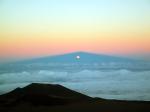 Moonrise Through Mauna Keas Shadow
2.12.2003
How can the Moon rise through a mountain? It cannot -- what was photographed here is a moonrise through the shadow of a large volcano. The volcano is Mauna Kea, Hawai'i, USA, a frequent spot for spectacular photographs since it is arguably the premier observing location on planet Earth.
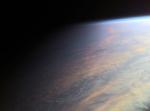 Earth at Twilight
11.06.2005
No sudden, sharp boundary marks the passage of day into night in this gorgeous view of ocean and clouds over our fair planet Earth. Instead, the shadow line or terminator is diffuse and shows the gradual transition to darkness we experience as twilight.
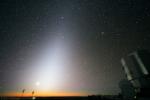 Zodiacal Light and the False Dawn
25.09.2007
An unusual triangle of light will be particularly bright near the eastern horizon before sunrise during the next two months for observers in Earth's northern hemisphere. Once considered a false dawn, this triangle of light is actually Zodiacal Light, light reflected from interplanetary dust particles.
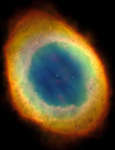 M57: The Ring Nebula
14.11.2009
It looks like a ring on the sky. Hundreds of years ago astronomers noticed a nebula with a most unusual shape. Now known as M57 or NGC 6720, the gas cloud became popularly known as the Ring Nebula.
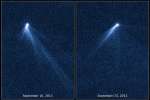 The Unexpected Tails of Asteroid P5
12.11.2013
What is happening to asteroid P/2013 P5? No one is sure. For reasons unknown, the asteroid is now sporting not one but six discernible tails. The above images were taken two months ago by the orbiting Hubble Space Telescope and show the rapidly changing dust streams.
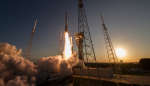 The Launch of OSIRIS REx
9.09.2016
Near sunset on Thursday, clear skies saw the launch of the OSIRIS-REx spacecraft. Sporting a single solid rocket booster, its Atlas V vehicle blasts off from Cape Canaveral's Complex 41 in this low, wide-angle view toward launch pad and setting Sun. OSIRIS-REx is bound for Bennu, scheduled to encounter the mountain-sized asteroid in 2018.
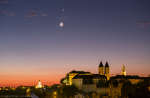 A September Morning Sky
20.09.2017
The Moon, three planets, and a bright star gathered near the ecliptic plane in the September 18 morning sky over Veszprem Castle, Hungary. In this twilight skyscape, Mercury and Mars still shine close to the eastern horizon, soon to disappear in the glare of the Sun.
|
January February March April May June July August September October |
|||||||||||||||||||||||||||||||||||||||||||||||||