
|
You entered: light
 APOD: 2025 July 10 Б Lynds Dark Nebula 1251
10.07.2025
Stars are forming in Lynds Dark Nebula (LDN) 1251. About 1,000 light-years away and drifting above the plane of our Milky Way galaxy, LDN 1251 is also less appetizingly known as "The Rotten Fish Nebula." The dusty molecular cloud is part of a complex of dark nebulae mapped toward the Cepheus flare region.
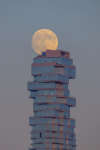 APOD: 2025 October 9 Б The Jenga Moon
9.10.2025
That big, bright, beautiful Full Moon you watched rise on the night of October 6 was the Harvest Moon. Famed in festival, story, and song, Harvest Moon is just the traditional name of the full moon nearest the time of the northern hemisphere's autumnal equinox. According to lore the name is a fitting one.
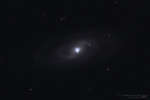 APOD: 2026 January 4 Б The Einstein Cross Gravitational Lens
4.01.2026
Most galaxies have a single nucleus -- does this galaxy have four? The strange answer leads astronomers to conclude that the nucleus of the surrounding galaxy is not even visible in this image. The central cloverleaf is rather light emitted from a background quasar.
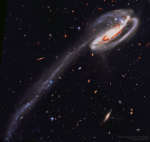 The Tadpole Galaxy from Hubble
21.06.2021
Why does this galaxy have such a long tail? In this stunning vista, based on image data from the Hubble Legacy Archive, distant galaxies form a dramatic backdrop for disrupted spiral galaxy Arp 188, the Tadpole Galaxy. The cosmic tadpole is a mere 420 million light-years distant toward the northern constellation of the Dragon (Draco).
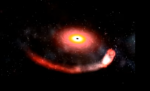 Unusual Signal Suggests Neutron Star Destroyed by Black Hole
3.09.2019
What created this unusual explosion? Three weeks ago, gravitational wave detectors in the USA and Europe -- the LIGO and Virgo detectors -- detected a burst of gravitational radiation that had the oscillating pattern expected when a black hole destroys a neutron star.
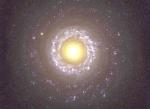 Spiral Galaxy NGC 7742
1.07.2001
This might resemble a fried egg you've had for breakfast, but it's actually much larger. In fact, ringed by blue-tinted star forming regions and faintly visible spiral arms, the yolk-yellow center of this face-on spiral galaxy, NGC 7742, is about 3,000 light-years across.
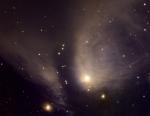 Portrait of RY Tauri
23.09.2005
A star emerges from its natal cloud of gas and dust in this tantalizing portrait of RY Tauri, a small stellar nursery at the edge of the Taurus molecular cloud, a mere 450 light-years away.
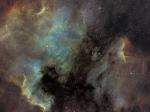 The North America and Pelican Nebulas
16.08.2006
Here are some familiar shapes in unfamiliar locations. This emission nebula on the left is famous partly because it resembles Earth's continent of North America. To the right of the North America Nebula, cataloged as NGC 7000, is a less luminous nebula that resembles a pelican dubbed the Pelican Nebula.
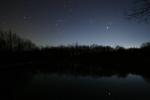 Venus by the Lake
14.04.2007
Finding Venus in the night sky is not too hard these days. Now appearing as the evening star, Venus rules as the brightest celestial beacon in west just after sunset. And if you can find Venus tonight, you can also easily find the lovely Pleiades star cluster (aka M45) close by.
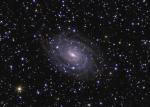 NGC 6384: Beyond the Stars
12.07.2007
The universe is filled with galaxies. But to see them astronomers must look out beyond the stars of our galaxy, the Milky Way. For example, consider this colorful telescopic view of spiral galaxy NGC 6384, about 80 million light-years away in the direction of the constellation Ophiuchus.
|
January February March April May June July August September October |
|||||||||||||||||||||||||||||||||||||||||||||||||