
|
You entered: light
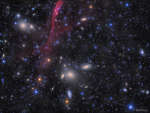 The Antlia Cluster of Galaxies
18.10.2016
Galaxies dot the sky in this impressively wide and deep image of the Antlia Cluster. The third closest cluster of galaxies to Earth after Virgo and Fornax, the Antlia cluster is known for its compactness and its high fraction of elliptical galaxies over (spirals.
 Earth at Night
9.07.2017
Can you find your favorite country or city? Surprisingly, on this world-wide nightscape, city lights make this task quite possible. Human-made lights highlight particularly developed or populated areas of the Earth's surface, including the seaboards of Europe, the eastern United States, and Japan.
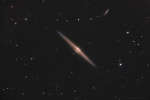 NGC 4565: Galaxy on Edge
22.02.2019
Magnificent spiral galaxy NGC 4565 is viewed edge-on from planet Earth. Also known as the Needle Galaxy for its narrow profile, bright NGC 4565 is a stop on many telescopic tours of the northern sky, in the faint but well-groomed constellation Coma Berenices.
 APOD: 2024 February 14 Б Rosette Deep Field
14.02.2024
Can you find the Rosette Nebula? The large, red, and flowery-looking nebula on the upper left may seem the obvious choice, but that is actually just diffuse hydrogen emission surrounding the Cone and Fox Fur Nebulas.
 The 37 Cluster
14.05.2024
For the mostly harmless denizens of planet Earth, the brighter stars of open cluster NGC 2169 seem to form a cosmic 37. Did you expect 42? From our perspective, the improbable numerical asterism appears solely by chance. It lies at an estimated distance of 3,300 light-years toward the constellation Orion.
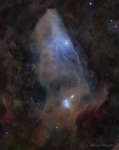 APOD: 2026 April 7 Б IC 4592: The Blue Horsehead Reflection Nebula
7.04.2026
Do you see the horse's head? What you are seeing is not the famous Horsehead nebula toward Orion, but rather a fainter nebula that only takes on a familiar form with deeper imaging. The main part of the here-imaged molecular cloud complex is reflection nebula IC 4592.
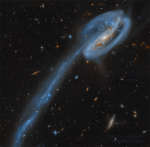 APOD: 2024 July 15 Б The Tadpole Galaxy from Hubble
15.07.2024
Why does this galaxy have such a long tail? In this stunning vista, based on image data from the Hubble Legacy Archive, distant galaxies form a dramatic backdrop for disrupted spiral galaxy Arp 188, the Tadpole Galaxy. The cosmic tadpole is a mere 420 million light-years distant toward the northern constellation of the Dragon (Draco).
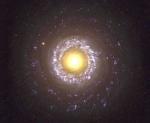 Spiral Galaxy NGC 7742
26.07.2003
This might resemble a fried egg you've had for breakfast, but it's actually much larger. In fact, ringed by blue-tinted star forming regions and faintly visible spiral arms, the yolk-yellow center of this face-on spiral galaxy, NGC 7742, is about 3,000 light-years across.
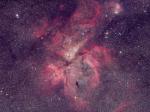 NGC 3372: The Great Nebula in Carina
17.05.2004
In one of the brightest parts of the Milky Way lies a nebula where some of the oddest things occur. NGC 3372, known as the Great Nebula in Carina, is home to massive stars and changing nebula.
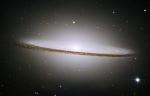 The Sombrero Galaxy from HST
15.01.2006
Why does the Sombrero Galaxy look like a hat? Reasons include the Sombrero's unusually large and extended central bulge of stars, and dark prominent dust lanes that appear in a disk that we see nearly edge-on. Billions of old stars cause the diffuse glow of the extended central bulge.
|
January February March April May June July August September October |
|||||||||||||||||||||||||||||||||||||||||||||||||