
|
You entered: light
 Regulus and the Dwarf Galaxy
26.04.2024
In northern hemisphere spring, bright star Regulus is easy to spot above the eastern horizon. The alpha star of the constellation Leo, Regulus is the spiky star centered in this telescopic field of view.
 APOD: 2024 December 11 Б The Shells and Jets of Galaxy Centaurus A
11.12.2024
What's the closest active galaxy to planet Earth? That would be Centaurus A, cataloged as NGC 5128, which is only 12 million light-years distant. Forged in a collision of two otherwise normal galaxies...
 APOD: 2025 July 14 Б NGC 2685: The Helix Galaxy
14.07.2025
What is going on with this galaxy? NGC 2685 is a confirmed polar ring galaxy - a rare type of galaxy with stars, gas and dust orbiting in rings perpendicular to the plane of a flat galactic disk.
 Astro 2 In Orbit
17.03.2001
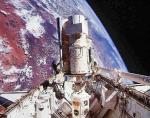
Six years ago, a cluster of three ultraviolet telescopes flew into orbit on the Astro-2 mission aboard the space shuttle Endeavour. Seen here perched in Endeavour's payload bay about 350 kilometers above the Australian desert are the Hopkins Ultraviolet Telescope (HUT), the Ultraviolet Imaging Telescope (UIT), and the Wisconsin Ultraviolet Photo-Polarimeter Experiment (WUPPE).
 Earth at Night
22.08.2004
This is what the Earth looks like at night. Can you find your favorite country or city? Surprisingly, city lights make this task quite possible. Human-made lights highlight particularly developed or populated areas of the Earth's surface, including the seaboards of Europe, the eastern United States, and Japan.
 Double Cluster in Perseus
7.12.2007
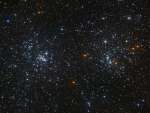
Skygazers recently following Comet Holmes have probably also chanced across this lovely starfield, not far from the comet on the sky in the constellation Perseus. Some 7,000 light-years away, this pair of open or galactic star clusters is an easy binocular target and is visible to the unaided eye from dark sky areas.
 Vela Supernova Remnant
6.03.2008
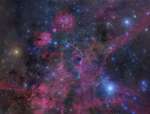
The plane of our Milky Way Galaxy runs through this complex and beautiful skyscape. At the northwestern edge of the constellation Vela (the Sails) the 16 degree wide, 30 frame mosaic is centered on the glowing filaments of the Vela Supernova Remnant, the expanding debris cloud from the death explosion of a massive star.
 NGC 3621: Far Beyond the Local Group
19.09.2009
Far beyond the local group of galaxies lies NGC 3621, some 22 million light-years away. Found in the multi-headed southern constellation Hydra, the winding spiral arms of this gorgeous island universe are loaded with luminous young star clusters and dark dust lanes.
 Sisters of the Dusty Sky
18.11.2010
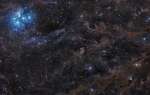
Hurtling through a cosmic dust cloud some 400 light-years away, the lovely Pleiades or Seven Sisters star cluster is well-known for its striking blue reflection nebulae. In the dusty sky toward the constellation Taurus and the Orion Arm of our Milky Way Galaxy, this remarkable image shows the famous star cluster at the upper left.
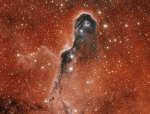 An Unusual Globule in IC 1396
14.04.2014
Is there a monster in IC 1396? Known to some as the Elephant's Trunk Nebula, parts of gas and dust clouds of this star formation region may appear to take on foreboding forms, some nearly human. The only real monster here, however, is a bright young star too far from Earth to hurt us.
|
January February March April May June July August September October |
|||||||||||||||||||||||||||||||||||||||||||||||||