
|
You entered: light
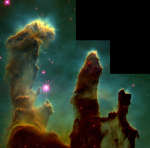 M16: Pillars of Creation
28.03.2010
It has become one of the most famous images of modern times. This image, taken with the Hubble Space Telescope in 1995, shows evaporating gaseous globules (EGGs) emerging from pillars of molecular hydrogen gas and dust.
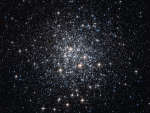 M72: A Globular Cluster of Stars
12.05.2010
Globular clusters once ruled the Milky Way. Back in the old days, back when our Galaxy first formed, perhaps thousands of globular clusters roamed our Galaxy. Today, there are less than 200 left. Many globular clusters were destroyed over the eons by repeated fateful encounters with each other or the Galactic center.
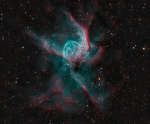 NGC 2359: Thor s Helmet
15.02.2014
This helmet-shaped cosmic cloud with wing-like appendages is popularly called Thor's Helmet. Heroically sized even for a Norse god, Thor's Helmet is about 30 light-years across. In fact, the helmet is more...
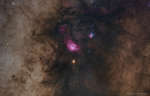 The Creature from the Red Lagoon
24.11.2014
What creature lurks near the red Lagoon nebula? Mars. This gorgeous color deep-sky photograph has captured the red planet passing below two notable nebulae -- cataloged by the 18th century cosmic registrar Charles Messier as M8 and M20.
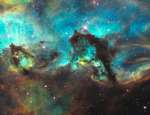 The Seahorse of the Large Magellanic Cloud
29.11.2014
It may look like a grazing seahorse, but the dark object toward the image right is actually a pillar of smoky dust about 20 light years long. The curiously-shaped dust structure occurs in our neighboring Large Magellanic Cloud, in a star forming region very near the expansive Tarantula Nebula.
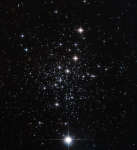 Palomar 12
18.02.2015
Palomar 12 was not born here. The stars of the globular cluster, first identified in the Palomar Sky Survey, are younger than those in other globular star clusters that roam the halo of our Milky Way Galaxy.
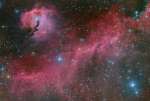 The Seagull Nebula
29.08.2015
A broad expanse of glowing gas and dust presents a bird-like visage to astronomers from planet Earth, suggesting its popular moniker - The Seagull Nebula. This portrait of the cosmic bird covers a 1.6 degree wide swath across the plane of the Milky Way, near the direction of Sirius, alpha star of the constellation Canis Major.
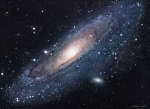 M31: The Andromeda Galaxy
17.12.2018
What is the nearest major galaxy to our own Milky Way Galaxy? Andromeda. In fact, our Galaxy is thought to look much like Andromeda. Together these two galaxies dominate the Local Group of galaxies. The diffuse light from Andromeda is caused by the hundreds of billions of stars that compose it.
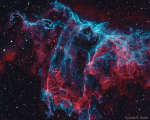 NGC 6995: The Bat Nebula
25.11.2019
Do you see the bat? It haunts this cosmic close-up of the eastern Veil Nebula. The Veil Nebula itself is a large supernova remnant, the expanding debris cloud from the death explosion of a massive star.
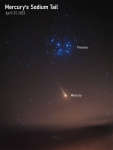 Mercurys Sodium Tail
3.05.2022
That's no comet. Below the Pleiades star cluster is actually a planet: Mercury. Long exposures of our Solar System's innermost planet may reveal something unexpected: a tail. Mercury's thin atmosphere contains small amounts of sodium that glow when excited by light from the Sun.
|
January February March April May June July August September October |
|||||||||||||||||||||||||||||||||||||||||||||||||