
|
You entered: Earth
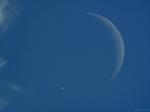 A Daylight Eclipse of Venus
20.06.2007
Something was about to happen. Just two days ago, two of the three celestial objects easily visible during the day appeared to collide. But actually, Earth's Moon passed well in front of the distant planet Venus. The occultation was caught from Switzerland in the hours before sunset.
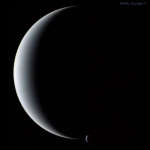 Crescent Neptune and Triton
27.05.2023
Gliding through the outer Solar System, in 1989 the Voyager 2 spacecraft looked toward the Sun to find this view of most distant planet Neptune and its moon Triton together in a crescent phase. The elegant image of ice-giant planet and largest moon was taken from behind just after Voyager's closest approach.
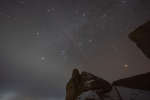 Trail of the Returner
31.12.2020
Familiar stars of a northern winter's night shine in this night skyview, taken near Zhangye, Gansu, China and the border with Inner Mongolia. During the early hours of December 17 Orion is near...
 Comet Leonards Tail Wag
10.01.2022
Why does Comet Leonard's tail wag? The featured time-lapse video shows the ion tail of Comet C/2021 A1 (Leonard) as it changed over ten days early last month. The video was taken by NASA's Solar Terrestrial Relations Observatory-Ahead (STEREO-A) spacecraft that co-orbits the Sun at roughly the same distance as the Earth.
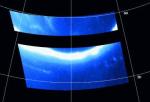 An Auroral Ring on Jupiter
9.06.1997
Do other planets have aurora? Terrestrial and spacecraft observations have found evidence for aurora on Venus, Mars, Jupiter, Saturn, Uranus, and Neptune. In the above false-color photograph, a good portion of an auroral ring was captured recently in optical light by the Galileo spacecraft in orbit around Jupiter.
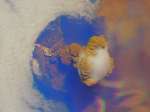 Sarychev Peak Volcano in Stereo
25.06.2009
From 400 kilometers above planet Earth, the Expedition 20 Crew onboard the International Space Station (ISS) was able to witness a remarkable event from a remarkable vantage point -- the June 12 eruption of the Sarychev Peak Volcano. The active volcano is located in Russia's Kuril Island chain, stretching to the northeast of Japan.
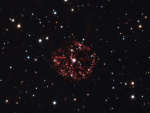 GK Per: Nova of 1901
5.11.2011
Early in the 20th century, GK Persei briefly became one of the brightest stars in planet Earth's sky, an event known as Nova Persei 1901. Documented in this modern day composite of two images from 2003 and 2011 the ejecta from the explosion, popularly called the Firework Nebula, continues to expand into space.
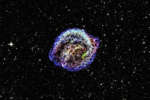 Kepler's Supernova Remnant in X Rays
15.05.2013
What caused this mess? Some type of star exploded to create the unusually shaped nebula known as Kepler's supernova remnant, but which type? Light from the stellar explosion that created this energized cosmic cloud was first seen on planet Earth in October 1604, a mere four hundred years ago.
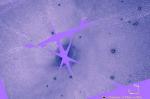 Planet Building in HD 100546
2.05.2001
More than 100 billion boulders may be swarming in the disk around nearby star HD 100546. In a scene thought similar to the early years of our own Solar System, ever larger rocks are growing by colliding and accreting dust as the messy business of planet formation appears to be underway.
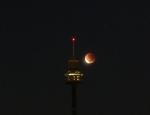 Good Morning Sydney
8.05.2004
Rising before dawn on May 5th, Stephen Thorley looked out across the skyline of Sydney, Australia. And while a leisurely lunar eclipse was clearly in progress, from his vantage point on planet Earth the Moon set as the total phase of the eclipse began.
|
January February March April May June July August September October |
|||||||||||||||||||||||||||||||||||||||||||||||||