
|
You entered: Earth
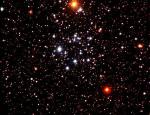 Open Cluster M50
28.01.1997
Many stars form in clusters. Two types of star clusters are visible in our Milky Way Galaxy: open clusters and globular clusters. Open clusters like M50, shown above, typically contain hundreds of stars, many of which are bright, young, and blue.
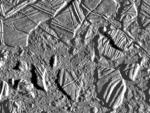 Europa's Ice Rafts
10.04.1997
The surface of Jupiter's moon Europa has shifted. Photographs released yesterday of Europa's surface taken by the spacecraft Galileo show that the smooth moon's icy surface is sometimes like a giant scrambled jigsaw puzzle. Pieces of Europa's surface, identifiable above, have rafted to new locations.
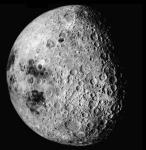 Far Side of the Moon
8.10.1998
Locked in synchronous rotation, the Moon always presents its well-known near side to Earth. But from lunar orbit, Apollo astronauts also grew to know the Moon's far side. This sharp picture from Apollo...
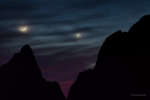 Twilight in a Western Sky
31.03.2018
A slender crescent Moon and inner planets Venus and Mercury never wander far from the Sun in planet Earth's skies. In the fading evening twilight of March 18, they line up near the western horizon in this atmospheric skyscape.
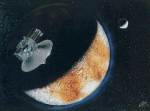 Pluto Not Yet Explored
12.02.1996
Cold, distant, Pluto is the only planet in our Solar System which has not been visited by a spacecraft from Earth. The story goes that the legend "Pluto Not Yet Explored" on a US postal stamp depicting the tiny, mysterious world inspired a JPL employee to develop plans for a Pluto flyby.
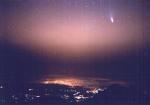 Hale-Bopp Brightest Comet This Century
25.03.1997
A comet as bright as Comet Hale-Bopp is very rare indeed. No comet has emitted or reflected this much light since possibly the Great Comet of 1811. However, since Comet Hale-Bopp is across the inner Solar System from us, it does not appear as bright as Comet West did in 1975.
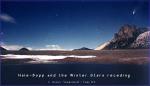 Hale-Bopp and Orion
29.04.1997
Comet Hale-Bopp is still brighter than most constellations. In fact, Comet Hale-Bopp may now hold the record for staying bright the longest. Last week the comet was photographed above in the same field...
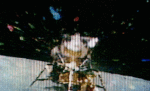 Blasting Off from the Moon
13.12.1998
How did the astronauts get back from the Moon? The Lunar Module that landed two astronauts on the Moon actually came apart. The top part containing the astronauts carried additional rocket fuel which allowed it to blast away, leaving the bottom part on the Moon forever.
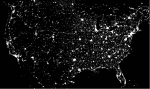 The United States at Night
30.08.1997
This is what the United States of America looks like at night! Can you find your favorite US city on this image? Surprisingly, city lights make this task quite possible. The above picture is actually a composite of over 200 images made by satellites orbiting the Earth.
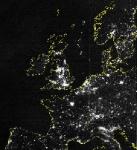 Europe at Night
7.10.1997
This is what Europe looks like at night! Can you find your favorite European city? Although not all of Europe is shown, city lights might make this task possible. Continental outlines have been artificially drawn in yellow. The above picture is actually a composite of over 200 images made by satellites orbiting the Earth.
|
January February March April May June July August September October |
|||||||||||||||||||||||||||||||||||||||||||||||||