
|
You entered: Earth
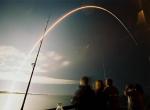 SIRTF Streak
5.09.2003
Streaking skyward, a Boeing Delta 2-Heavy rocket carries NASA's Space InfraRed Telescope Facility (SIRTF) aloft during the early morning hours of August 25th. The dramatic scene was recorded in a time exposure from...
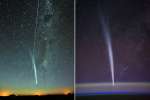 Comet Lovejoy and the ISS
31.12.2011
On December 24, Comet Lovejoy rose in dawn's twilight, arcing above the eastern horizon, its tails swept back by the solar wind and sunlight. Seen on the left is the comet's early morning appearance alongside the southern Milky Way from the town of Intendente Alvear, La Pampa province, Argentina.
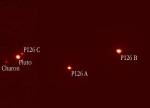 Pluto and Charon Eclipse a Triple Star
11.09.2002
Occasionally, a planet in our Solar System will pass in front of a bright star. Since stars and planets take up so little space on the sky, such events are quite rare. Two months ago, however, Pluto and its large moon Charon passed in front of a comparatively bright triple star system known as P126.
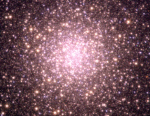 Globular Cluster M3
6.12.1996
This huge ball of stars predates our Sun. Long before mankind evolved, before dinosaurs roamed, and even before our Earth existed, ancient globs of stars condensed and orbited a young Milky Way Galaxy.
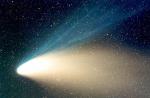 A Star Cluster Through Hale-Bopp's Tail
16.04.1997
Comet Hale-Bopp continues to look impressive. The photograph above captured the comet on April 7th passing nearly in front of M34, a star cluster in the constellation of Perseus. Many of the stars in this open cluster can be seen through Comet Hale-Bopp's white dust tail.
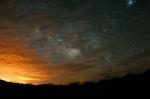 Star Clouds over Arizona
24.04.2006
The clouds in the foreground are much different than the clouds in the background. In the foreground are a photogenic deck of Earth-based water clouds. The long exposure used to create the above photograph makes the light from the left, reflected from Phoenix, Arizona, USA, appear like a sunset.
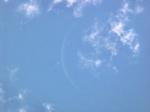 Crescent Venus and Moon
30.10.2006
There's something behind these clouds. Those faint graceful arcs, upon inspection, are actually far, far in the distance. They are the Earth's Moon and the planet Venus. Both the Moon and Venus are bright enough to be seen during the day, and both are quite capable of showing a crescent phase.
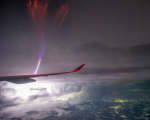 Gigantic Jet Lightning over India
18.09.2019
Yes, but can your lightning bolt do this? While flying from Munich to Singapore earlier this month, an industrious passenger took images of a passing lightning storm and caught something unexpected: gigantic jet lightning. The jet was captured on a single 3.2-second exposure above Bhadrak, India.
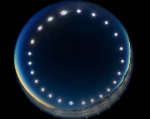 Eclipse on a Polar Day
10.12.2021
During polar day, in Arctic and Antarctic summer, the Sun stays above the horizon for periods of 24 hours or more. Recorded on December 4, this fisheye timelapse image tracks the Sun in multiple frames as it completes a circle in the summer sky above Union Glacier, Antarctica.
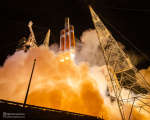 Launch of the Parker Solar Probe
15.08.2018
When is the best time to launch a probe to the Sun? The now historic answer -- which is not a joke because this really happened this past weekend -- was at night. Night, not only...
|
January February March April May June July August September October |
|||||||||||||||||||||||||||||||||||||||||||||||||