
|
You entered: Earth
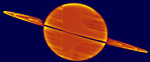 Sunlight Through Saturn's Rings
11.05.1996
Normally, Earth based astronomers view Saturn's spectacular ring system fully illuminated by reflected sunlight. However, this November 1995 Hubble Space Telescope composite image was made to take advantage of an unusual perspective, with the Sun actually illuminating the rings from below.
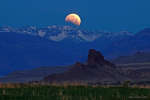 Eclipsed Moon Over Wyoming
6.06.2012
A setting full moon rarely looks like this. Monday morning just before a fully lit Strawberry Moon dropped behind the Absaroka Mountain Range near Cody, Wyoming, USA, the shadow of the Earth got in the way.
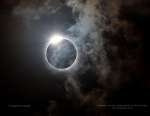 Diamond Ring and Shadow Bands
21.11.2012
As the total phase of last week's solar eclipse came to an end, sunlight streaming past the edge of the Moon created the fleeting appearance of a glistening diamond ring in the sky.
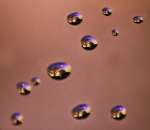 Venus Through Water Drops
26.01.2017
Now the brilliant "star" in planet Earth's evening skies, Venus is captured in this creative astrophotograph. Taken with a close-focusing lens on January 18 from Milton Keynes, UK, it shows multiple images of the sky above the western horizon shortly after sunset.
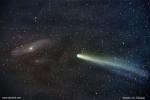 A Galaxy is not a Comet
12.04.2002
This gorgeous galaxy and comet portrait was recorded on April 5th in the skies over the Oriental Pyrenees near Figueres, Spain. From a site above 1,100 meters, astrophotographer Juan Carlos Casado used...
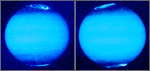 Jupiter's Auroras
18.10.1996
Auroras are especially large on Jupiter. In pictures released yesterday, the Hubble Space Telescope imaged these unusual light displays in more detail than ever before. Jupiter's auroras are linked to its volcanic moon Io.
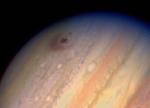 Impact on Jupiter
28.07.1998
In 1993, a strange string of comet pieces was discovered near the planet Jupiter. So unusual a sight, Comet Shoemaker-Levy 9 (SL9) quickly became the object of much scientific curiosity. Studies showed that the Sun would soon perturb the orbit of SL9 so that it would actually
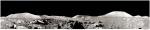 Apollo 17 Panorama: Astronaut Running
9.12.2006
What would it be like to explore the surface of another world? In 1972 during the Apollo 17 mission, astronaut Harrison Schmitt found out first hand. In this case, the world was Earth's own Moon.
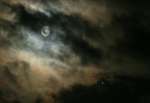 Moons and Jupiter
14.07.2009
Earth's Moon and planet Jupiter made a beautiful pairing in the night sky late last week. This skyscape recorded on July 11 from Brittany in north western France captures the bright conjunction through a cloud bank.
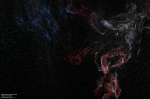 NGC 7841: The Smoke Nebula in Frustriaus
1.11.2013
NGC 7841 is probably known as the Smoke Nebula, found in the modern constellation of Frustriaus, the frustrated astrophotographer. Only a few light-nanoseconds from planet Earth, The Smoke Nebula is not an expanding supernova remnant along the plane of our Milky Way galaxy, though it does look a lot like one.
|
January February March April May June July August September October |
|||||||||||||||||||||||||||||||||||||||||||||||||