
|
You entered: Earth
 Flying Over Plutos Moon Charon
21.02.2016
Given some poetic license, there is now scientific evidence that hell has frozen over. To start, Greek mythology holds that Charon is the ferryman of the underworld. Next, recent analysis of data taken...
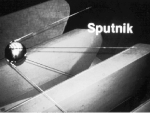 Sputnik: The Traveling Companion
10.02.1996
Sputnik means "traveling companion". In stark contrast to this innocent sounding name, the launch of the Earth's first "artificial moon", Sputnik 1, by the Soviets on October 4, 1957 shocked the free world, setting in motion events which resulted in the creation of NASA and the race to the Moon.
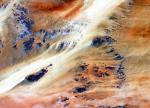 Terkezi Oasis in the Sahara Desert
11.11.2002
Dominating the top third of Africa is the largest band of dry land on Earth: the Sahara Desert. Stretching across the Sahara are vast planes of sand and gravel, seas of sand dunes, and barren rocky mountains.
 Olympus Mons From Orbit
19.10.1998
Olympus Mons on Mars is the largest volcano in the Solar System. Although three times higher than Earth's Mount Everest, Olympus Mons would not be difficult to climb because of the volcano's great breadth.
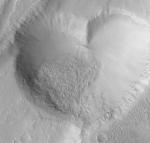 From Mars with Love
28.06.1999
Are Martians trying to tell us something? An indentation has been recently photographed on Mars that resembles a heart, a common human symbol for love. Because intelligent Martians have never been known to exist...
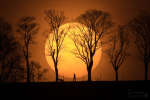 Man, Dog, Sun
10.04.2017
This was supposed to be a shot of trees in front of a setting Sun. Sometimes, though, the unexpected can be photogenic. During some planning shots, a man walking his dog unexpected crossed the ridge. The result was so striking that, after cropping, it became the main shot.
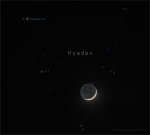 Moon in the Hyades
19.04.2018
Have you seen the Moon lately? On April 18, its waxing sunlit crescent moved through planet Earth's night across a background of stars in the Hyades. Anchored by bright star Aldebaran, the nearby, V-shaped star cluster and complete lunar orb appear in this telephoto image.
 APOD: 2024 April 9 Б Moon Shadow over Lake Magog
8.04.2024
Captured in this snapshot, the shadow of the Moon came to Lake Magog, Quebec, North America, planet Earth on April 8. For the lakeside eclipse chasers, the much anticipated total solar eclipse was a spectacle to behold in briefly dark, but clear skies.
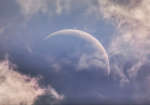 APOD: 2026 June 20 Б Daytime Moon Meets Evening Star
19.06.2026
Venus is now appearing on the celestial stage as Earth's brilliant evening star, performing with the Moon, other wandering planets, and bright stars in western skies. For evening sky gazers on June 17, the celestial beacon rose after sunset close by a young, slender, crescent Moon.
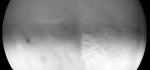 A Global Dust Storm on Mars
1.10.2001
A dust storm on Mars can involve nearly the entire planet. As spring descended on the southern hemisphere of the red planet this June and July, a global dust storm raged. Pictured above is the storm on July 8 as it spread up from the south, oriented on the lower right.
|
January February March April May June July August September October |
|||||||||||||||||||||||||||||||||||||||||||||||||