
|
You entered: Earth
 A Cosmic Call to Nearby Stars
12.07.2009
If Earth received this message from deep space, could we decode it? The people from the Cosmic Call project sent the above image as the first page of a longer message. The message was broadcast toward local stars by radio telescope during the summer of 1999. Another message was sent in 2003.
 Galileo Demonstrates the Telescope
30.08.1996
Galileo Galilei made a good discovery great. Upon hearing at age 40 that a Dutch optician had invented a glass that made distant objects appear larger, Galileo crafted his own telescope and turned it toward the sky.
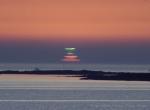 A Green Flash from the Sun
10.11.2002
Many think it is just a myth. Others think it is true but its cause isn't known. Adventurers pride themselves on having seen it. It's a green flash from the Sun. The truth is the green flash does exist and its cause is well understood.
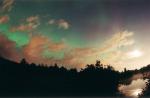 Aurora Over Clouds
10.09.2003
Aurorae usually occur high above the clouds. The auroral glow is created when fast-moving particles ejected from the Sun impact air molecules high in the Earth's atmosphere. An oxygen molecule, for example, will glow in a green light when reacquiring an electron lost during a collision with a solar particle.
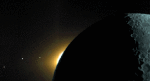 The Ecliptic Plane
29.05.1999
The Plane of the Ecliptic is illustrated in this Clementine star tracker camera image which reveals (from right to left) the Moon lit by Earthshine, the Sun's corona rising over the Moon's dark limb, and the planets Saturn, Mars, and Mercury.
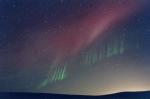 Rays from an Unexpected Aurora
20.11.2005
This aurora was a bit of a surprise. For starters, on this Friday morning in August 2002, no intense auroral activity was expected at all. Possibly more surprising, however, the aurora appeared to show an usual structure of green rays from some locations.
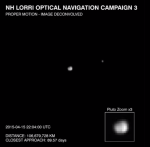 Approaching Pluto
27.05.2015
Here comes Pluto. NASA's robotic New Horizons spacecraft is now beyond the orbit of Neptune and closing fast on the Solar System's most famous unexplored world. The featured time lapse video shows...
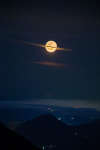 A Moon Dressed Like Saturn
16.03.2020
Why does Saturn appear so big? It doesn't -- what is pictured are foreground clouds on Earth crossing in front of the Moon. The Moon shows a slight crescent phase with most of its surface visible by reflected Earthlight known as ashen glow.
 Full Observatory Moon
27.01.2024
A popular name for January's full moon in the northern hemisphere is the Full Wolf Moon. As the new year's first full moon, it rises over Las Campanas Observatory in this dramatic Earth-and-moonscape. Peering from the foreground like astronomical eyes are the observatory's twin 6.5 meter diameter Magellan telescopes.
 Yogi Rock
11.07.1997
This portrait of Yogi Rock, a now famous boulder on Mars, was recorded on Sol 3 by the Imager for Mars Pathfinder (IMP). Big and friendly looking like its Earth cartoon namesake Yogi Bear, Yogi Rock is a prominent visible feature at the Pathfinder landing site.
|
January February March April May June July August September October |
|||||||||||||||||||||||||||||||||||||||||||||||||