
|
You entered: Earth
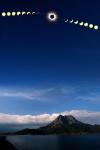 A Total Solar Eclipse over Turkey
4.04.2006
Some views of last week's total eclipse of the Sun were better than others. One spectacular view occurred over Adrasan (near Antalya), Turkey and was captured there by industrious astrophotographer Stefan Seip. The above digital mosaic caught the Moon in several stages as it moved between the Earth and the Sun.
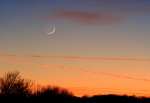 Mercury Chases the Sunset
12.01.2008
This colorful view of the western sky at sunset features last Wednesday's slender crescent Moon. Of course, when the Moon is in its crescent phase it can never be far from Sun in the sky.
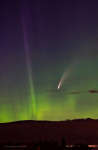 NEOWISE of the North
17.07.2020
After local midnight on July 14 comet NEOWISE was still above the horizon for Goldenrod, Alberta, Canada, just north of Calgary, planet Earth. In this snapshot it makes for an awesome night with dancing displays of the northern lights. The long-tailed comet and auroral displays are beautiful apparitions in the north these days.
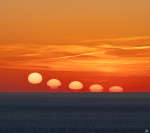 APOD: 2026 April 25 Б The Persistence of Sunlight
25.04.2026
This seaside sunset offered a surreal experience, captured in a sea and skyscape from the west coast of Sardinia, Italy, planet Earth. The Daliesque scene is a composition of sequential exposures made with a camera and long telephoto lens. The Sun is not melting, though.
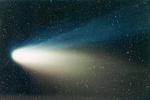 Comet Hale-Bopp's Developing Tail
14.03.1997
Comet Hale-Bopp is living up to its expectations. Besides the brightness of its coma, a comet is typically remembered by the length of its tails. As visible in the above picture taken last week, Comet Hale-Bopp's blue ion tail shows a dramatic extension, with current reports of about 20 degrees from dark locations.
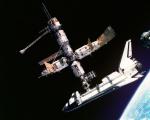 The Space Shuttle Docked with Mir
20.10.2002
Before there was the International Space Station, the reigning orbiting spaceport was Russia's Mir. Pictured above in 1995, the United States Space Shuttle Atlantis docked with the segmented Mir. During shuttle mission STS-71, astronauts answered questions from school students over amateur radio and performed science experiments aboard Spacelab.
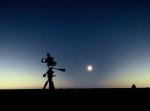 Shadow Cone of a Total Solar Eclipse
6.01.2003
Sometimes, during a total eclipse of the Sun, a strange shadow of darkness can be seen stretching off into the distance. Called a shadow cone, they are visible because the Earth's atmosphere is not completely transparent, scattering sunlight and hence appearing blue during the day.
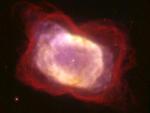 Planetary Nebula NGC 7027 in Infrared
25.03.1998
NGC 7027 is one of the smallest known planetary nebulae. Even so, NGC 7027 is 14,000 times larger than the Earth-Sun distance. Planetary nebula are so named because the first few discovered appeared similar to planets. Planetary nebula are actually dying stars, though, that have recently run out of nuclear fuel.
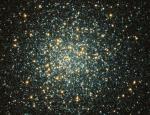 Globular Cluster M3
15.09.2003
This huge ball of stars predates our Sun. Long before humankind evolved, before dinosaurs roamed, and even before our Earth existed, ancient globs of stars condensed and orbited a young Milky Way Galaxy.
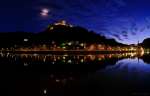 Lunar Corona over Cochem Castle
25.05.2013
This bat-like apparition does not shine on clouds passing over Gotham city. Instead, the cloud bank in silhouette against a colorful lunar corona was spotted on the evening of May 18 over Cochem, Germany from the banks of the river Mossele.
|
January February March April May June July August September October |
|||||||||||||||||||||||||||||||||||||||||||||||||