
|
You entered: Earth
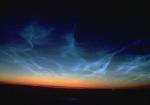 Noctilucent Clouds
15.06.2003
Sometimes it's night on the ground but day in the air. As the Earth rotates to eclipse the Sun, sunset rises up from the ground. Therefore, at sunset on the ground, sunlight still shines on clouds above.
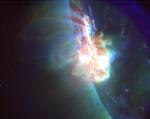 An Active Region of the Sun
16.06.1998
The Sun is a busy place. This false-color image depicts an active region near an edge of the Sun. Hot plasma is seen exploding off the Sun's photosphere and traveling along loops defined by the Sun's magnetic field.
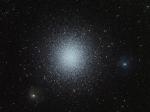 M13: The Great Globular Cluster in Hercules
11.05.2004
M13 is one of the most prominent and best known globular clusters. Visible with binoculars in the constellation of Hercules, M13 is frequently one of the first objects found by curious sky gazers seeking celestials wonders beyond normal human vision.
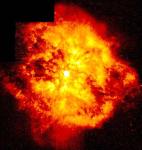 WR124: Stellar Fireball
9.11.1998
Some stars explode in slow motion. Rare, massive Wolf-Rayet stars are so tumultuous and hot they are disintegrating right before our telescopes. Glowing gas globs each over 30 times more massive than the Earth are being expelled by a violent stellar wind.
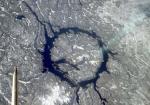 Manicouagan Impact Crater
1.01.2005
Manicouagan Crater in northern Canada is one of the oldest impact craters known. Formed about 200 million years ago, the present day terrain supports a 70-kilometer diameter hydroelectric reservoir in the telltale form of an annular lake. The crater itself has been worn away by the passing of glaciers and other erosional processes.
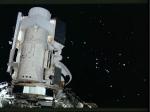 Astro 1 In Orbit
3.12.2005
Fifteen years ago, in December of 1990, the Space Shuttle Orbiter Columbia carried an array of astronomical telescopes high above the Earth's obscuring atmosphere to explore the Universe at ultraviolet and x-ray wavelengths.
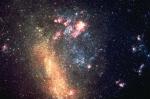 Neighboring Galaxy: The Large Magellanic Cloud
22.02.2000
The brightest galaxy visible from our own Milky Way Galaxy is the Large Magellanic Cloud (LMC). Visible predominantly from Earth's Southern Hemisphere, the LMC is the second closest galaxy, neighbor to the Small Magellanic Cloud, and one of eleven known dwarf galaxies that orbit our Milky Way Galaxy.
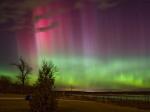 Aurora Over Iowa
18.12.2006
Last Thursday evening, stars were not the only lights in Iowa skies. Spectacular northern lights also shone from the heavens, extending across the midwestern USA and other locations not often graced with auroral displays.
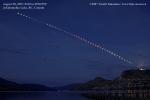 Kalamalka Lake Eclipse
1.09.2007
Recorded on August 28th, this serene total lunar eclipse sequence looks southwest down Kalamalka Lake toward the lights of Coldstream, British Columbia. An exposure every 4 minutes captured the Moon's position and eclipse phase, until the Moon set behind the town lights and a hill on the horizon.
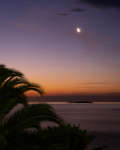 Crescent Moon Occultation
25.02.2023
On February 22, a young Moon shared the western sky at sunset with bright planets Venus and Jupiter along the ecliptic plane. The beautiful celestial conjunction was visible around planet Earth. But from some locations Jupiter hid for a while, occulted by the crescent lunar disk.
|
January February March April May June July August September October |
|||||||||||||||||||||||||||||||||||||||||||||||||