
|
You entered: dust
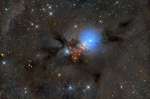 NGC 1333: Stellar Nursery in Perseus
5.11.2015
NGC 1333 is seen in visible light as a reflection nebula, dominated by bluish hues characteristic of starlight reflected by interstellar dust. A mere 1,000 light-years distant toward the heroic constellation Perseus, it lies at the edge of a large, star-forming molecular cloud.
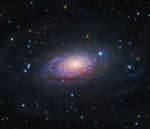 Messier 63: The Sunflower Galaxy
12.07.2017
A bright spiral galaxy of the northern sky, Messier 63 is about 25 million light-years distant in the loyal constellation Canes Venatici. Also cataloged as NGC 5055, the majestic island universe is nearly 100,000 light-years across. That's about the size of our own Milky Way Galaxy.
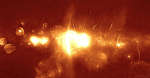 The Galactic Center in Radio from MeerKAT
8.07.2019
What's happening at the center of our galaxy? It's hard to tell with optical telescopes since visible light is blocked by intervening interstellar dust. In other bands of light, though, such as radio, the galactic center can be imaged and shows itself to be quite an interesting and active place.
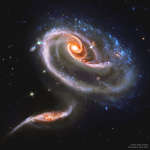 Arp 273: Battling Galaxies from Hubble
20.11.2019
What's happening to these spiral galaxies? Although details remain uncertain, there sure seems to be a titanic battle going on. The upper galaxy is labelled UGC 1810 by itself, but together with its collisional partners is known as Arp 273.
 Iron in the Butterfly Nebula
21.07.2020
Can stars, like caterpillars, transform themselves into butterflies? No, but in the case of the Butterfly Nebula -- it sure looks like it. Though its wingspan covers over 3 light-years and its estimated surface temperature...
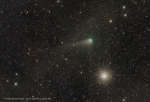 Messier 10 and Comet
21.07.2022
Imaged on July 15 2022, comet C/2017 K2 (PanSTARRS) had a Messier moment, sharing this wide telescopic field of view with globular star cluster Messier 10. Of course M10 was cataloged by 18th century comet hunter Charles Messier as the 10th object on his list of things that were definitely not comets.
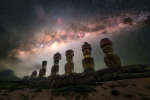 APOD: 2026 March 25 Б The Guardians of Rapa Nui beneath the Milky Way
25.03.2026
In the words of today's astrophotographer, Rositsa Dimitrova, "What have these silent sentinels watched pass across the sky?" The volcanic mo'ai (meaning statue) of Ahu Tongariki stand guard over Rapa Nui (Isla...
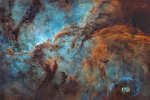 APOD: 2026 July 7 Б NGC 6188: Dragons of Ara
7.07.2026
Where can you find dragons fighting in the night sky? In the southern constellation of the Altar: Ara. The dragons are, of course, actually made of suggestively shaped gas and dust. The celestial home...
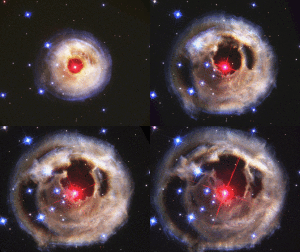 V838 Light Echo: The Movie
2.04.2003
What caused this outburst of V838 Mon? For reasons unknown, star V838 Mon's outer surface suddenly greatly expanded with the result that it became the brightest star in the entire Milky Way Galaxy. Then, just as suddenly, it faded.
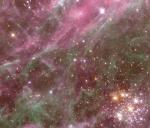 Denizen of the Tarantula Nebula
3.05.2003
The star cluster at lower right, cataloged as Hodge 301, is a denizen of the Tarantula Nebula. An evocative nebula in the southern sky, the sprawling cosmic Tarantula is an energetic star forming region some 168,000 light-years distant in our neighboring galaxy the Large Magellanic Cloud.
|
January February March April May June July August September October |
|||||||||||||||||||||||||||||||||||||||||||||||||