
|
You entered: dust
 APOD: 2025 August 25 Б The Meteor and the Star Cluster
25.08.2025
Sometimes even the sky surprises you. To see more stars and faint nebulosity in the Pleiades star cluster (M45), long exposures are made. Many times, less interesting items appear on the exposures that were not intended -- but later edited out.
 APOD: 2025 December 1 Б 3I ATLAS: Tails of an Interstellar Comet
1.12.2025
How typical is our Solar System? Studying 3I/ATLAS, a comet just passing through, is providing clues. Confirmed previous interstellar visitors include an asteroid, a comet, a meteor, and a gas wind dominated by hydrogen and helium.
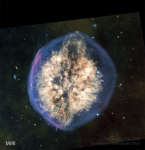 APOD: 2026 March 9 Б The Cranium Nebula from the Webb Telescope
9.03.2026
What's going on inside the head of this nebula? Dubbed the Exposed Cranium Nebula for its similarity to the human brain, what created the nebula remains a mystery. One thought is that the Cranium Nebula, also known as PMR 1, is a planetary nebula surrounding a white dwarf star.
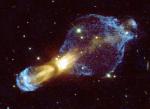 The Making of the Rotten Egg Nebula
3.09.2001
Fast expanding gas clouds mark the end for a central star in the Rotten Egg Nebula. The once-normal star has run out of nuclear fuel, causing the central regions to contract into a white dwarf. Some of the liberated energy causes the outer envelope of the star to expand.
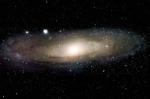 Andromeda Island Universe
18.05.2002
How far can you see? The most distant object easily visible to the unaided eye is M31, the great Andromeda Galaxy some two million light-years away. Without a telescope, even this immense spiral galaxy appears as an unremarkable, faint, nebulous cloud in the constellation Andromeda.
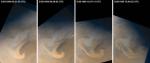 Mars Weather Watch
16.08.1999
Mars may be a cold, dry planet but its weather is dynamic. On June 30, wide angle cameras on board the Mars Global Surveyor (MGS) spacecraft watched the development of this large scale storm system above Mars' north polar area.
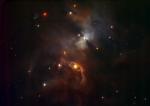 Stars Forming in Serpens
31.08.2007
Stars are forming in a dense molecular cloud a mere 1,000 light-years away in the constellation Serpens Cauda (The Serpent's Tail). At that estimated distance, this sharp, near-infrared close-up of the active Serpens star-forming region spans about 2 arcminutes or just over half a light-year.
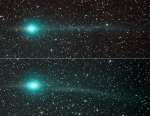 Comet Lulin Tails
7.02.2009
Sweeping through the inner solar system, Comet Lulin is easily visible in both northern and southern hemispheres with binoculars or a small telescope. Recent changes in Lulin's lovely greenish coma and tails are featured in this two panel comparison of images taken on January 31st (top) and February 4th.
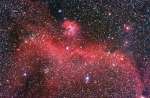 The Seagull Nebula
27.03.2009
Images from two different cameras, a digital SLR and an astronomical ccd camera, are combined in this color starscape. Both cameras made use of the same telescope at the oceanside Winter Star Party in the Florida Keys, appropriately creating this portrait of the Seagull Nebula.
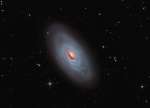 M64: The Black Eye Galaxy
4.04.2013
This beautiful, bright, spiral galaxy is Messier 64, often called the Black Eye Galaxy or the Sleeping Beauty Galaxy for its heavy-lidded appearance in telescopic views. M64 is about 17 million light-years distant in the otherwise well-groomed northern constellation Coma Berenices.
|
January February March April May June July August September October |
|||||||||||||||||||||||||||||||||||||||||||||||||