
|
You entered: dust
 APOD: 2026 May 25 Б Thackerays Globules
25.05.2026
What are these strange space globs? Situated in rich star fields and glowing hydrogen gas, these opaque clouds of interstellar dust and gas are so large they might be able to form stars. Their...
 The Center of Centaurus A
1.10.2000
A fantastic jumble of young blue star clusters, gigantic glowing gas clouds, and imposing dark dust lanes surrounds the central region of the active galaxy Centaurus A. This mosaic of Hubble Space Telescope images taken in blue, green, and red light has been processed to present a natural color picture of this cosmic maelstrom.
 Sail On Stardust
25.01.2001
Spacecraft on long interplanetary voyages often use the planets themselves as gravitational "sling shots" to boost them along their way. Launched in February of 1999 on a historic voyage to a comet, the Stardust spacecraft is no different.
 Comet LINEAR Disperses
8.08.2000
What's happened to the nucleus of Comet LINEAR? The brightest comet this year has unexpectedly broken up into many smaller pieces. The break-up occurred on or about July 25 and was noted by many astronomers around the world with particularly pioneering work by Mark Kidger (IAC).
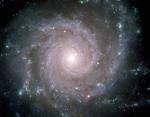 M74: The Perfect Spiral
4.10.2001
If not perfect, then this spiral galaxy is at least one of the most photogenic. An island universe of about 100 billion stars, 30 million light-years away toward the constellation Pisces, NGC 628 or M74 presents a gorgeous face-on view to earthbound astronomers.
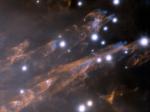 Bullet Pillars in Orion
26.03.2007
Why are bullets of gas shooting out of the Orion Nebula? Nobody is yet sure. First discovered in 1983, each bullet is actually about the size of our Solar System, and moving at about 400 km/sec from a central source dubbed IRc2.
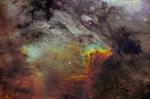 IC 5067: A Piece of the Pelican
19.10.2007
(xxxedit and linkxxx) The prominent ridge of emission featured in this dramatic skyscape is cataloged as IC 5067. Part of a larger emission nebula with a distinctive shape, popularly called The Pelican Nebula, the ridge spans about 10 light-years following the curve of the cosmic pelican's head and neck.
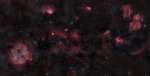 Cepheus: Trunk to Bubble
9.09.2010
Star clusters, glowing nebulae and dark dust clouds abound in Cepheus, royal constellation of the northern hemisphere. You can follow them in amazing detail across this broad skyscape, a mosaic of telescopic images spanning about 17 degrees. Beginning at the lower left, the large emission nebula is cataloged as IC 1396.
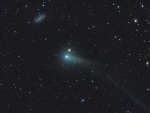 Comet PanSTARRS with Galaxy
6.06.2014
Sweeping slowly through northern skies, the comet PanSTARRS C/2012 K1 posed for this telescopic portrait on June 2nd in the constellation Ursa Major. Now in the inner solar system, the icy body from the Oort cloud sports two tails, a lighter broad dust tail and crooked ion tail extending below and right.
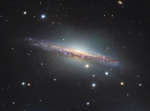 NGC 1055 Close up
9.11.2017
Big, beautiful spiral galaxy NGC 1055 is a dominant member of a small galaxy group a mere 60 million light-years away toward the aquatically intimidating constellation Cetus. Seen edge-on, the island universe spans over 100,000 light-years, a little larger than our own Milky Way.
|
January February March April May June July August September October |
|||||||||||||||||||||||||||||||||||||||||||||||||