
|
You entered: dust
 PanSTARRS: The Anti Tail Comet
29.06.2013
Once known as Earth's sunset comet, PanSTARRS (C/2011 L4) is up all night now, but only for northern hemisphere skygazers. Telescopes are required to track its progress as it fades and heads for the outer solar system.
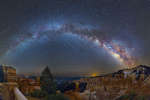 Meteors, Planes, and a Galaxy over Bryce Canyon
19.05.2014
Sometimes land and sky are both busy and beautiful. The landscape pictured in the foreground encompasses Bryce Canyon in Utah, USA, famous for its many interesting rock structures eroded over millions of years.
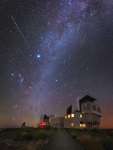 Geminids of the South
17.12.2015
Earth's annual Geminid meteor shower did not disappoint, peaking before dawn on December 14 as our fair planet plowed through dust from active asteroid 3200 Phaethon. Captured in this southern hemisphere nightscape the meteors stream away from the shower's radiant in Gemini.
 Curiosity Vista from Vera Rubin Ridge
10.09.2018
If you could stand on Mars -- what might you see? If you were NASA's Curiosity rover, just last month you would have seen the view from Vera Rubin Ridge, an intriguing rock-strewn perch on the side of Mount Sharp.
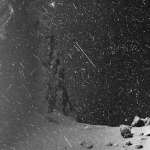 The Snows of Churyumov Gerasimenko
15.03.2020
You couldn't really be caught in this blizzard while standing by a cliff on Churyumov-Gerasimenko. Orbiting the comet -- frequently abbreviated as 67P or CG -- in June of 2016, the Rosetta spacecraft's narrow...
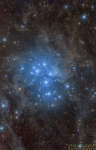 Pleiades: The Seven Sisters Star Cluster
9.09.2020
Have you ever seen the Pleiades star cluster? Even if you have, you probably have never seen it as large and clear as this. Perhaps the most famous star cluster on the sky, the bright stars of the Pleiades can be seen without binoculars from even the depths of a light-polluted city.
 M100: A Grand Design Spiral Galaxy
2.05.2024
Majestic on a truly cosmic scale, M100 is appropriately known as a grand design spiral galaxy. The large galaxy of over 100 billion stars has well-defined spiral arms, similar to our own Milky Way.
 APOD: 2025 January 26 Б The Many Tails of Comet G3 ATLAS
26.01.2025
Why does this comet have so many tails? C/2024 G3 (ATLAS) has developed several long and intricate tails visible from Earth's southern hemisphere over the past two weeks. Many observers reported seeing the impressive comet without any optical aid above the western horizon just after sunset.
 Herbig Haro 24
28.05.2025
This might look like a double-bladed lightsaber, but these two cosmic jets actually beam outward from a newborn star in a galaxy near you. Constructed from Hubble Space Telescope image data, the stunning scene...
 APOD: 2025 December 17 Б W5: The Soul Nebula
17.12.2025
Stars are forming in the Soul of the Queen of Aethopia. More specifically, a large star forming region called the Soul Nebula can be found in the direction of the constellation Cassiopeia, whom Greek mythology credits as the vain wife of a King who long ago ruled lands surrounding the upper Nile river.
|
January February March April May June July August September October |
|||||||||||||||||||||||||||||||||||||||||||||||||