
|
You entered: dust
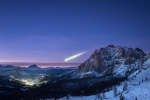 Major Fireball Meteor
17.11.2017
The sky glows with soft pinkish colors of fading twilight in this serendipitous mountaintop vista. Taken in subfreezing temperatures, the thoughtfully composed photo shows snowy, rugged peaks seen from a mountain pass on November 14. Below lies the village of La Villa, Alta Badia in Italy's Dolomite Alps.
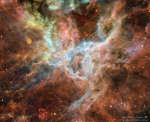 In the Heart of the Tarantula Nebula
20.05.2018
In the heart of monstrous Tarantula Nebula lies huge bubbles of energetic gas, long filaments of dark dust, and unusually massive stars. In the center of this heart, is a knot of stars so dense that it was once thought to be a single star.
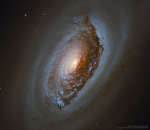 M64: The Evil Eye Galaxy
29.03.2021
Who knows what evil lurks in the eyes of galaxies? The Hubble knows -- or in the case of spiral galaxy M64 -- is helping to find out. Messier 64, also known as the Evil...
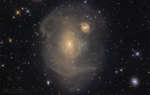 NGC 1316: After Galaxies Collide
17.05.2022
Astronomers turn detectives when trying to figure out the cause of startling sights like NGC 1316. Investigations indicate that NGC 1316 is an enormous elliptical galaxy that started, about 100 million years ago, to devour a smaller spiral galaxy neighbor, NGC 1317, just on the upper right.
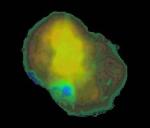 X-Rays From IC 443
2.05.1997
The life-cycles of stars help drive the ecology of our Galaxy, churning, processing, and redistributing matter. Massive stars reach a spectacular evolutionary endpoint - supernovae explosions which blast off their outer layers, violently merging stellar material with the gas and dust of the Milky Way. The supernova remnant IC 443 is typical of the aftermath.
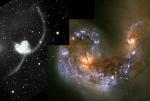 The Antennae Galaxies
22.10.1997
A ground-based telescopic view (left) of the collision between the galaxies NGC4038 and NGC4039 reveals long arcing insect-like "antennae" of luminous matter flung from the scene of the accident. Investigators using the Hubble Space...
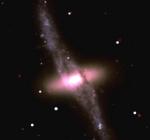 NGC 4650A: Strange Galaxy and Dark Matter
25.06.1998
This strangely distorted galaxy of stars is cataloged as NGC 4650A. It lies about 165 million light-years away in the southern constellation Centaurus. The complex system seems to have at least two parts, a flattened disk of stars with a dense, bright, central core and a sparse, sharply tilted ring of gas, dust and stars.
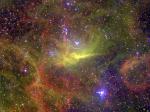 Nebulas Surrounding Wolf Rayet Binary
BAT99 49
Nebulas Surrounding Wolf Rayet Binary
BAT99 49
21.04.2004
How could two young stars power these colorful interstellar gas clouds? Although hidden by thick dust, the stars spew forceful ions and energetic radiation that cause the clouds to fragment and light up.
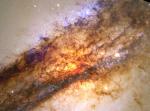 The Center of Centaurus A
17.07.2005
A fantastic jumble of young blue star clusters, gigantic glowing gas clouds, and imposing dark dust lanes surrounds the central region of the active galaxy Centaurus A. This mosaic of Hubble Space Telescope images taken in blue, green, and red light has been processed to present a natural color picture of this cosmic maelstrom.
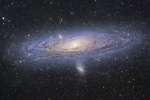 Andromeda Island Universe
24.01.2008
The most distant object easily visible to the unaided eye is M31, the great Andromeda Galaxy some two and a half million light-years away. But without a telescope, even this immense spiral galaxy - spanning over 200,000 light years - appears as a faint, nebulous cloud in the constellation Andromeda.
|
January February March April May June July August September October |
|||||||||||||||||||||||||||||||||||||||||||||||||