
|
You entered: constellation
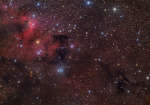 The Light, the Dark, and the Dusty
10.06.2015
This colorful skyscape spans about three full moons (1.5 degrees) across nebula rich starfields along the plane of our Milky Way Galaxy in the royal northern constellation Cepheus. Near the edge of the region...
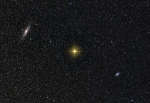 M31 versus M33
25.09.2015
Separated by about 14 degrees (28 Full Moons) in planet Earth's sky, spiral galaxies M31 at left, and M33 are both large members of the Local Group, along with our own Milky Way galaxy.
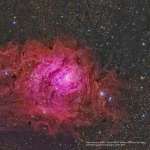 Pan STARRS Across the Lagoon
24.04.2019
Ridges of glowing interstellar gas and dark dust clouds inhabit the turbulent, cosmic depths of the Lagoon Nebula. Also known as M8, the bright star forming region is about 5,000 light-years distant.
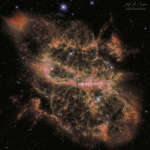 APOD: 2020 August 14 Б NGC 5189: An Unusually Complex Planetary Nebula
13.08.2020
Why is this nebula so complex? When a star like our Sun is dying, it will cast off its outer layers, usually into a simple overall shape. Sometimes this shape is a sphere, sometimes a double lobe, and sometimes a ring or a helix.
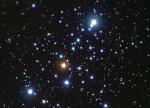 Distant Open Cluster M103
6.02.2001
Bright blue stars highlight the open cluster known as M103. The gas clouds from which these stars condensed has long dispersed. Of the stars that were formed, the brightest, bluest, and most massive have already used up their nuclear fuel and self-destructed in supernova explosions.
 Planet Building in HD 100546
2.05.2001
More than 100 billion boulders may be swarming in the disk around nearby star HD 100546. In a scene thought similar to the early years of our own Solar System, ever larger rocks are growing by colliding and accreting dust as the messy business of planet formation appears to be underway.
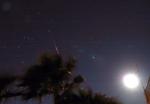 Leonids vs The Moon
19.11.2002
Beautiful and bright, the 2002 Leonid meteors battled against glaring moonlight. This winning example, from Tuesday morning skies above Laughlin, Nevada, USA, finds an undaunted Leonid streaking between the familiar constellation of Orion (left) and an overexposed full Moon.
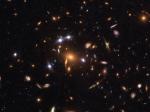 A Five Quasar Gravitational Lens
24.05.2006
What's happening near the center of this cluster of galaxies? At first glance, it appears that several strangely elongated galaxies and fully five bright quasars exist there. In reality, an entire cluster of galaxies is acting as a gigantic gravitational lens that distorts and multiply-images bright objects that occur far in the distance.
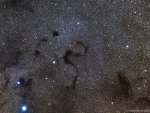 Snake in the Dark
19.02.2009
Dark nebulae snake across a gorgeous expanse of stars in this telescopic view toward the pronounceable constellation Ophiuchus and the center of our Milky Way Galaxy. In fact, the twisting central shape seen here is well known as the Snake Nebula.
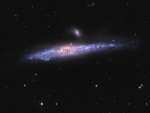 The Whale Galaxy
2.05.2009
NGC 4631 is a big beautiful spiral galaxy. Seen edge-on, it lies only 25 million light-years away in the well-trained northern constellation Canes Venatici. The galaxy's slightly distorted wedge shape suggests to some a cosmic herring and to others its popular moniker, The Whale Galaxy.
|
January February March April May June July August September October |
|||||||||||||||||||||||||||||||||||||||||||||||||