
|
You entered: constellation
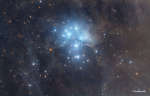 M45: The Pleiades Star Cluster
19.10.2016
Have you ever seen the Pleiades star cluster? Even if you have, you probably have never seen it as dusty as this. Perhaps the most famous star cluster on the sky, the bright stars of the Pleiades can be seen without binoculars even from the heart of a light-polluted city.
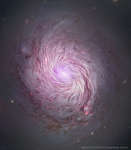 The Magnetic Fields of Spiral Galaxy M77
16.12.2019
Can magnetic fields help tell us how spiral galaxies form and evolve? To find out, the HAWC+ instrument on NASA's airborne (747) SOFIA observatory observed nearby spiral galaxy M77. HAWC+ maps magnetism by observing polarized infrared light emitted by elongated dust grains rotating in alignment with the local magnetic field.
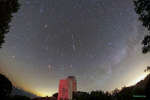 Tau Herculids Meteors over Kitt Peak Telescopes
1.06.2022
It wasn't the storm of the century -- but it was a night to remember. Last night was the peak of the Tau Herculids meteor shower, a usually modest dribble of occasional meteors originating from the disintegrating Comet 73P/Schwassmann-Wachmann 3.
 APOD: 2025 April 28 Б Gum 37 and the Southern Tadpoles
28.04.2025
This cosmic skyscape features glowing gas and dark dust clouds alongside the young stars of NGC 3572. A beautiful emission nebula and star cluster, it sails far southern skies within the nautical constellation Carina.
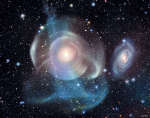 APOD: 2026 July 12 Б Galaxy NGC 474: Shells and Star Streams
12.07.2026
What's happening to galaxy NGC 474? The multiple layers of emission appear strangely complex given the relatively featureless appearance of the elliptical galaxy in less deep images. The cause of the shells...
 The Crab that Played with the Planet
10.01.2003
Wandering through the constellation Taurus, Saturn made its closest approach to planet Earth last month, tilting its lovely rings toward appreciative skygazers while rising high in midnight skies. On January 4th and 5th, Saturn...
 NGC 1700: Elliptical Galaxy and Rotating Disk
16.01.2003
In spiral galaxies, majestic winding arms of young stars and interstellar gas and dust rotate in a disk around a bulging galactic nucleus. Elliptical galaxies seem to be simpler, randomly swarming with old stars and lacking gas and dust.
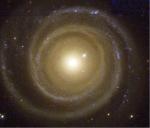 The Spiral Arms of NGC 4622
21.02.2004
While stirring a morning cup of coffee and thinking cosmic thoughts many astronomers would glance at this Hubble Space Telescope image of spiral galaxy NGC 4622 and assume that the galaxy was rotating counterclockwise in the picture.
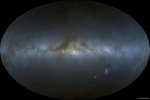 All Sky Milky Way Panorama
25.11.2009
If you could go far away from the Earth and look around the entire sky -- what would you see? Such was the goal of the All-Sky Milky Way Panorama 2.0 project of Axel Mellinger.
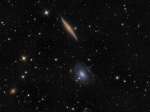 NGC 5965 and NGC 5963 in Draco
16.02.2012
These two spiral galaxies make a photogenic pair, found within the boundaries of the northern constellation Draco. Contrasting in color and orientation, NGC 5965 is nearly edge-on to our line of sight and dominated by yellow hues, while bluish NGC 5963 is closer to face-on.
|
January February March April May June July August September October |
|||||||||||||||||||||||||||||||||||||||||||||||||