
|
You entered: constellation
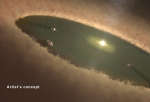 The Double Dust Disks of HD 95086
16.11.2014
What do other star systems look like? To help find out, astronomers are carrying out detailed observations of nearby stars in infrared light to see which have dust disks that might be forming planets.
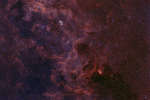 Cosmic Clouds in Cygnus
8.06.2022
These cosmic clouds of gas and dust drift through rich star fields along the plane of our Milky Way Galaxy toward the high flying constellation Cygnus. They're too faint to be seen with the unaided eye though, even on a clear, dark night.
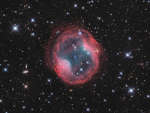 Jones Emberson 1
23.02.2023
Planetary nebula Jones-Emberson 1 is the death shroud of a dying Sun-like star. It lies some 1,600 light-years from Earth toward the sharp-eyed constellation Lynx. About 4 light-years across, the expanding remnant...
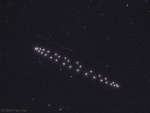 APOD: 2026 May 6 Б The Retrograde Dance of Saturn and Neptune
5.05.2026
What does it mean for Saturn and Neptune to be in retrograde? Featured is a composite of images taken over 34 nights from May 2025 to February 2026 tracing Saturn (brighter, foreground) and Neptune (dimmer, background). Over that time, the two planets exhibited retrograde motion, meaning they appeared to move backward in the sky.
 Distortion from a Distant Cluster
23.08.2001
This stunning color deep sky view toward the constellation Pisces was made with data from a fast, sensitive, digital detector known as the Big Throughput Camera operating at Cerro Tololo Inter-American Observatory in Chile.
 Sagittarius Triplet
14.06.2006
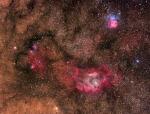
These three bright nebulae are often featured in telescopic tours of the constellation Sagittarius and the crowded starfields of the central Milky Way. In fact, 18th century cosmic tourist Charles Messier cataloged two of them; M8, the nebula below and right of center, and colorful M20 at the upper right.
 NGC 7008: The Fetus Nebula
25.08.2008
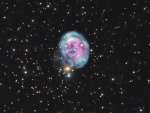
Compact and round, NGC 7008 is recognized as a planetary nebula about 2,800 light-years distant in the nebula rich constellation of Cygnus. This impressive telescopic view shows off NGC 7008's remarkable colors...
 Hickson Compact Group 90
12.03.2009
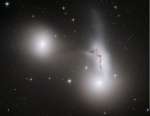
Scanning the skies for galaxies, Canadian astronomer Paul Hickson and colleagues identified some 100 compact groups of galaxies, now appropriately called Hickson Compact Groups (HCGs). This sharp Hubble image shows one such galaxy group, HCG 90, in startling detail.
 A Halo for NGC 6164
7.05.2009
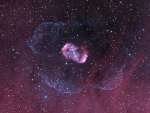
Beautiful emission nebula NGC 6164 was created by a rare, hot, luminous O-type star, some 40 times as massive as the Sun. Seen at the center of the cosmic cloud, the star is a mere 3 to 4 million years old.
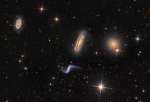 Hickson 44 in Leo
29.08.2011
Scanning the skies for galaxies, Canadian astronomer Paul Hickson and colleagues identified some 100 compact groups of galaxies, now appropriately called Hickson Compact Groups. The four prominent galaxies seen in this intriguing telescopic skyscape are one such group, Hickson 44, about 100 million light-years distant toward the constellation Leo.
|
January February March April May June July August September October |
|||||||||||||||||||||||||||||||||||||||||||||||||