
|
You entered: constellation
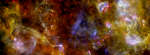 Herschel s Cygnus X
17.05.2012
The Herschel Space Observatory's infrared view of Cygnus X spans some 6x2 degrees across one of the closest, massive star forming regions in the plane of our Milky Way galaxy. In fact, the rich stellar nursery already holds the massive star cluster known as the Cygnus OB2 association.
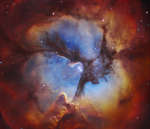 In the Center of the Trifid Nebula
28.01.2013
Clouds of glowing gas mingle with dust lanes in the Trifid Nebula, a star forming region toward the constellation of the Archer (Sagittarius). In the center, the three prominent dust lanes that give the Trifid its name all come together.
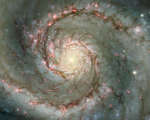 M51: The Whirlpool Galaxy in Dust and Stars
24.02.2013
The Whirlpool Galaxy is a classic spiral galaxy. At only 30 million light years distant and fully 60 thousand light years across, M51, also known as NGC 5194, is one of the brightest and most picturesque galaxies on the sky.
 Mars, Ceres, Vesta
10.04.2014
That bright, ruddy star you've recently noticed rising just after sunset isn't a star at all. That's Mars, the Red Planet. Mars is now near its 2014 opposition (April 8) and closest approach (April 14), looping through the constellation Virgo opposite the Sun in planet Earth's sky.
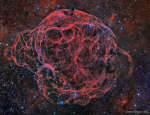 Simeis 147: Supernova Remnant
17.05.2017
It's easy to get lost following intricate filaments in this detailed image of faint supernova remnant Simeis 147. Also cataloged as Sharpless 2-240 it goes by the popular nickname, the Spaghetti Nebula. Seen toward the boundary of the constellations Taurus and Auriga, it covers nearly 3 degrees or 6 full moons on the sky.
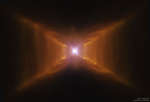 The Red Rectangle Nebula from Hubble
8.05.2018
How was the unusual Red Rectangle nebula created? At the nebula's center is an aging binary star system that surely powers the nebula but does not, as yet, explain its colors. The unusual...
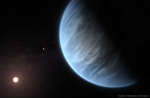 Water Vapor Discovered on Distant Exoplanet
16.09.2019
Where else might life exist? One of humanity's great outstanding questions, locating planets where extrasolar life might survive took a step forward recently with the discovery of a significant amount of water vapor in the atmosphere of distant exoplanet K2-18b.
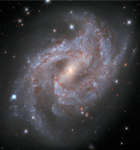 Supernova in NGC 2525
22.10.2020
Big, beautiful, barred spiral galaxy NGC 2525 lies 70 million light-years from the Milky Way. It shines in Earth's night sky within the boundaries of the southern constellation Puppis. About 60,000 light-years...
 The Tarantula Nebula from SuperBIT
26.04.2023
The Tarantula Nebula, also known as 30 Doradus, is more than a thousand light-years in diameter, a giant star forming region within nearby satellite galaxy the Large Magellanic Cloud. About 160 thousand light-years away, it's the largest, most violent star forming region known in the whole Local Group of galaxies.
 APOD: 2024 December 9 Б Pleiades: The Seven Sisters Star Cluster
8.12.2024
Have you ever seen the Pleiades star cluster? Even if you have, you probably have never seen it as large and clear as this. Perhaps the most famous star cluster on the sky, the bright stars of the Pleiades can be seen with the unaided eye even from the depths of a light-polluted city.
|
January February March April May June July August September October |
|||||||||||||||||||||||||||||||||||||||||||||||||