
|
You entered: star
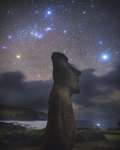 Orion above Easter Island
18.09.2017
Why were the statues on Easter Island built? No one is sure. What is sure is that over 800 large stone statues exist there. The Easter Island statues, stand, on the average, over twice as tall as a person and have over 200 times as much mass.
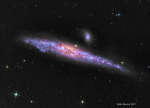 NGC 4631: The Whale Galaxy
6.10.2022
NGC 4631 is a big beautiful spiral galaxy. Seen edge-on, it lies only 25 million light-years away in the well-trained northern constellation Canes Venatici. The galaxy's slightly distorted wedge shape suggests to some a cosmic herring and to others its popular moniker, The Whale Galaxy.
 APOD: 2023 October 18 Б Dust and the Western Veil Nebula
18.10.2023
It's so big it is easy to miss. The entire Veil Nebula spans six times the diameter of the full moon, but is so dim you need binoculars to see it. The nebula was created about 15,000 years ago when a star in the constellation of the Swan (Cygnus) exploded.
 APOD: 2024 May 29 Б Stairway to the Milky Way
29.05.2024
What happens if you ascend this stairway to the Milky Way? Before answering that, let's understand the beautiful sky you will see. Most eye-catching is the grand arch of the Milky Way Galaxy...
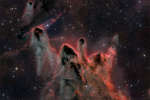 APOD: 2024 July 16 Б Cometary Globules
16.07.2024
What are these unusual interstellar structures? Bright-rimmed, flowing shapes gather near the center of this rich starfield toward the borders of the nautical southern constellations Pupis and Vela. Composed of interstellar gas and dust, the grouping of light-year sized cometary globules is about 1300 light-years distant.
 Spiral Galaxy NGC 6744
1.11.2024
Big, beautiful spiral galaxy NGC 6744 is nearly 175,000 light-years across, larger than our own Milky Way. It lies some 30 million light-years distant in the southern constellation Pavo but appears as only a faint smudge in the eyepiece of a small telescope.
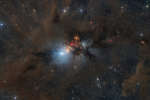 NGC 1333: Stellar Nursery in Perseus
30.01.2026
NGC 1333 is seen in visible light as a reflection nebula, dominated by bluish hues characteristic of starlight reflected by interstellar dust. A mere 1,000 light-years distant toward the heroic constellation Perseus, it lies at the edge of a large, star-forming molecular cloud.
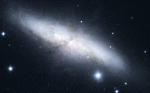 Unusual M82: The Cigar Galaxy
18.11.1996
Something strange happened to this galaxy, but what? M82 is a nearby galaxy in the group of galaxies dominated by itself, M81, and NGC 3077. M82 is thought by some to be limping away from a close encounter with M81.
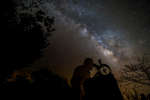 Along the Milky Way
3.07.2021
You can't walk along the Milky Way. Still, under a dark sky you can explore it. To the eye the pale luminous trail of light arcing through the sky on a dark, moonless night does appear to be a path through the heavens.
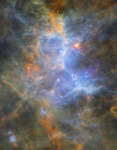 Herschel s Eagle Nebula
28.07.2016
A now famous picture from the Hubble Space Telescope featured Pillars of Creation, star forming columns of cold gas and dust light-years long inside M16, the Eagle Nebula. This false-color composite image views...
|
January February March April May June July August September October |
|||||||||||||||||||||||||||||||||||||||||||||||||