
|
You entered: star
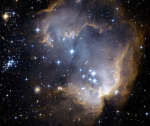 NGC 602 and Beyond
13.01.2013
Near the outskirts of the Small Magellanic Cloud, a satellite galaxy some 200 thousand light-years distant, lies 5 million year young star cluster NGC 602. Surrounded by natal gas and dust, NGC 602 is featured in this stunning Hubble image of the region.
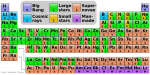 Where Your Elements Came From
25.01.2016
The hydrogen in your body, present in every molecule of water, came from the Big Bang. There are no other appreciable sources of hydrogen in the universe. The carbon in your body was made by nuclear fusion in the interior of stars, as was the oxygen.
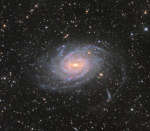 Spiral Galaxy NGC 6744
5.12.2019
Beautiful spiral galaxy NGC 6744 is nearly 175,000 light-years across, larger than our own Milky Way. It lies some 30 million light-years distant in the southern constellation Pavo and appears as only a faint, extended object in small telescopes.
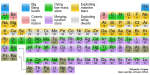 The Origin of Elements
9.08.2020
The hydrogen in your body, present in every molecule of water, came from the Big Bang. There are no other appreciable sources of hydrogen in the universe. The carbon in your body was made by nuclear fusion in the interior of stars, as was the oxygen.
 APOD: 2025 September 19 Б The NGC 6914 Complex
19.09.2025
A study in contrasts, this colorful cosmic skyscape features stars, dust, and glowing gas in the vicinity of NGC 6914. The interstellar complex of nebulae lies some 6,000 light-years away, toward the high-flying northern constellation Cygnus and the plane of our Milky Way Galaxy.
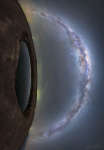 APOD: 2026 April 19 Б Eye on the Milky Way
19.04.2026
Have you ever had stars in your eyes? It appears that the eye on the left does, and moreover, it appears to be gazing at even more stars. The featured 27-frame mosaic was taken in 2019 from Ojas de Salar in the Atacama Desert of Chile.
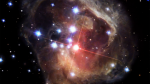 V838 Light Echo: The Movie
17.06.2014
What caused this outburst of V838 Mon? For reasons unknown, star V838 Mon suddenly became one of the brightest stars in the entire Milky Way Galaxy. Then, just a few months later, it faded.
 APOD: 2025 April 27 Б IC 418: The Spirograph Nebula
27.04.2025
What is creating the strange texture of IC 418? Dubbed the Spirograph Nebula for its resemblance to drawings from a cyclical drawing tool, planetary nebula IC 418 shows patterns that are not well understood. Perhaps they are related to chaotic winds from the variable central star, which changes brightness unpredictably in just a few hours.
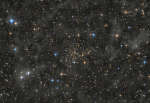 APOD: 2026 May 13 Б NGC 188: Old Cluster in the New General Catalog
13.05.2026
The New General Catalog of star clusters and nebulae really isn't so new. In fact, it was published in 1888 - an effort by J. L. E. Dreyer to consolidate the work of astronomers William, Caroline, and John Herschel along with others into a useful single, complete catalog of astronomical discoveries and measurements.
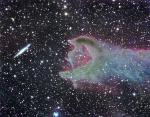 CG4: A Ruptured Cometary Globule
13.10.2002
The odd looking "creature" to the right of center in the above photo is a gas cloud known as a cometary globule. This globule, however, has ruptured. Cometary globules are typically characterized by dusty heads and elongated tails.
|
January February March April May June July August September October |
|||||||||||||||||||||||||||||||||||||||||||||||||