
|
You entered: star
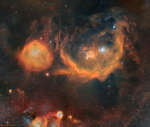 The Interstellar Clouds of Orion
5.06.2019
The constellation of Orion is much more than three stars in a row. It is a direction in space that is rich with impressive nebulas. To better appreciate this well-known swath of sky, a new long exposure image was taken over several clear nights in January, February and March.
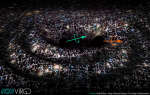 GW190521: Unexpected Black Holes Collide
8.09.2020
How do black holes like this form? The two black holes that spiraled together to produce the gravitational wave event GW190521 were not only the most massive black holes ever seen by LIGO and VIRGO so far, their masses -- 66 and 85 solar masses -- were unprecedented and unexpected.
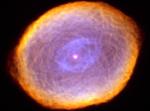 IC 418: The Spirograph Nebula
30.09.2001
What is creating the strange texture of IC 418? Dubbed the Spirograph Nebula for its resemblance to drawings from a cyclical drawing tool, planetary nebula IC 418 shows patterns that are not well understood. Perhaps they are related to chaotic winds from the variable central star, which changes brightness unpredictably in just a few hours.
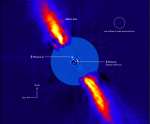 Probably a Planet for Beta Pic
28.11.2008
A mere 50 light-years away, young star Beta Pictoris became one of the most important stars in the sky in the early 1980s. Satellite and ground-based telescopic observations revealed the presence of a surrounding...
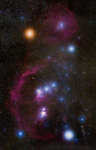 Camera Orion
21.03.2018
Do you recognize this constellation? Although it is one of the most recognizable star groupings on the sky, Orion's icons don't look quite as colorful to the eye as they do to a camera.
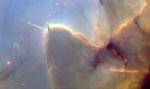 Trifid Pillars and Jets
30.12.2001
Dust pillars are like interstellar mountains. They survive because they are more dense than their surroundings, but they are being slowly eroded away by a hostile environment. Visible in the above picture...
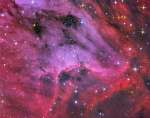 Pelican Nebula Close Up
19.08.2010
The prominent ridge of emission featured in this intensely colorful skyscape is designated IC 5067. Part of a larger emission nebula with a distinctive shape, popularly called The Pelican Nebula, the ridge spans about 10 light-years and follows the curve of the cosmic pelican's head and neck.
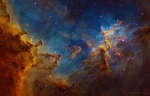 Melotte 15 in the Heart
18.10.2014
Cosmic clouds form fantastic shapes in the central regions of emission nebula IC 1805. The clouds are sculpted by stellar winds and radiation from massive hot stars in the nebula's newborn star cluster, Melotte 15.
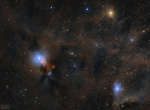 Stardust in the Perseus Molecular cloud
14.01.2017
Clouds of stardust drift through this deep skyscape. The cosmic scene spans nearly 2 degrees across the Perseus molecular cloud some 850 light-years away. A triangle of dusty nebulae reflecting light from embedded stars is captured in the telescopic field of view.
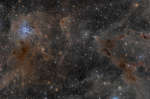 The Iris Nebula in a Field of Dust
12.09.2019
These cosmic dust clouds drift some 1,300 light-years away along the fertile starfields of the constellation Cepheus. The beautiful Iris Nebula, also known as NGC 7023, blossoms at the upper left. Not the only nebula in the sky to evoke the imagery of flowers, its pretty, symmetric form spans about 6 light-years.
|
January February March April May June July August September October |
|||||||||||||||||||||||||||||||||||||||||||||||||