
|
You entered: ionization
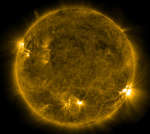 Equinox and the Iron Sun
23.09.2010
Today, the Sun crosses the celestial equator heading south at 03:09 Universal Time. Known as an equinox, this astronomical event marks the first day of autumn in the northern hemisphere and spring in the south. Equinox means equal night.
GB-finalLeshin1024.preview.jpg) The Elephant s Trunk Nebula in Cepheus
The Elephant s Trunk Nebula in Cepheus
18.01.2017
Like an illustration in a galactic Just So Story, the Elephant's Trunk Nebula winds through the emission nebula and young star cluster complex IC 1396, in the high and far off constellation of Cepheus. Also known as vdB 142, the cosmic elephant's trunk is over 20 light-years long.
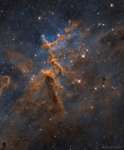 Melotte 15 inthe Heart
9.02.2017
Cosmic clouds form fantastic shapes in the central regions of emission nebula IC 1805. The clouds are sculpted by stellar winds and radiation from massive hot stars in the nebula's newborn star cluster, Melotte 15.
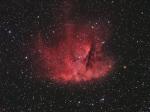 NGC 281: The Pacman Nebula
23.08.2005
NGC 281 is a busy workshop of star formation. Prominent features include a small open cluster of stars, a diffuse red-glowing emission nebula, large lanes of obscuring gas and dust, and dense knots of dust and gas in which stars may still be forming.
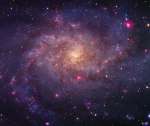 Bright Nebulae in M33
17.10.2009
Gorgeous spiral galaxy M33 seems to have more than its fair share of bright emission nebulae. In fact, narrow-band and broad-band image data are combined in this beautifully detailed composite to trace the reddish emission nebulae, star forming HII regions, sprawling along loose spiral arms that wind toward the galaxy's core.
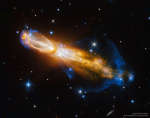 The Calabash Nebula from Hubble
14.02.2017
Fast expanding gas clouds mark the end for a central star in the Calabash Nebula. The once-normal star has run out of nuclear fuel, causing the central regions to contract into a white dwarf. Some of the liberated energy causes the outer envelope of the star to expand.
 APOD: 2025 July 5 Б Ou4: The Giant Squid Nebula
4.07.2025
Difficult to capture, this mysterious, squid-shaped interstellar cloud spans nearly three full moons in planet Earth's sky. Discovered in 2011 by French astro-imager Nicolas Outters, the Squid Nebula's bipolar shape is distinguished here by the telltale blue emission from doubly ionized oxygen atoms.
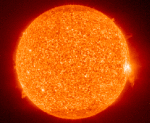 Helios Helium
20.05.1996
Above is an image of the relatively quiet Sun made on May 18 in light emitted by ionized Helium atoms in the Solar chromosphere. Helium was first discovered in the Sun in 1868, its name fittingly derived from from the Greek word Helios, meaning Sun. Credit for the discovery goes to astronomer Joseph Lockyer.
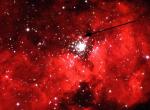 Sher 25: A Pending Supernova?
12.08.1997
No supernova has ever been predicted - yet. These dramatic stellar explosions that destroy stars, that create and disperse the elements that compose people and planets, that light up the night sky, are not so well understood that astronomers can accurately predict when a star will explode - yet. Perhaps Sher 25 will be the first.
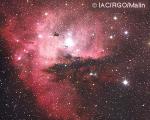 NGC 281: Cluster, Clouds, and Globules
21.09.1998
NGC 281 is a busy workshop of star formation. Prominent features include a small open cluster of stars, a diffuse red-glowing emission nebula, large lanes of obscuring gas and dust, and dense knots of dust and gas in which stars may still be forming.
|
January February March April May June July August |
||||||||||||||||||||||||||||||||||||||||||||||||||||||||