
|
You entered: ionization
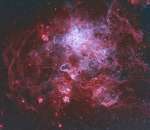 The Tarantula Nebula
16.11.2017
The Tarantula Nebula is more than a thousand light-years in diameter, a giant star forming region within nearby satellite galaxy the Large Magellanic Cloud, about 180 thousand light-years away. The largest, most violent star...
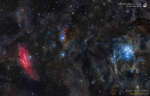 From California to the Pleiades
22.11.2013
An astronomical trip from the California Nebula to the Pleiades star cluster would cover just 12 degrees across planet Earth's night sky. That's equivalent to the angular extent of 25 Full Moons, as your telescope sweeps over the borders of the constellations Perseus and Taurus.
 The Colors of Comet Hyakutake
29.03.1996
The colors of Comet Hyakutake are caused by the action of sunlight on the dust and gas produced by the warming nucleus. The microscopic dust particles reflect sunlight while the sun's ultraviolet radiation excites and ionizes the gas molecules causing them to glow or fluoresce in a range of visible colors.
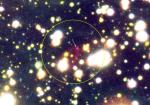 The Nebula And The Neutron Star
1.02.2003
The lonely RX J1856.5-3754 was formed from the collapsed core of an exploding star. At a distance of 180 light-years it is the closest known neutron star. More massive than...
 The Hydrogen Clouds of M33
30.09.2021
Gorgeous spiral galaxy M33 seems to have more than its fair share of glowing hydrogen gas. A prominent member of the local group of galaxies, M33 is also known as the Triangulum Galaxy and lies a mere 3 million light-years away.
 APOD: 2023 August 2 Б M82: Galaxy with a Supergalactic Wind
2.08.2023
Why is the Cigar Galaxy billowing red smoke? M82, as this starburst galaxy is also known, was stirred up by a recent pass near large spiral galaxy M81. This doesn't fully explain the source of the red-glowing outwardly expanding gas and dust, however.
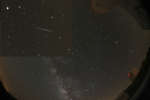 A Twisted Meteor Trail Over Tenerife
2.06.2010
Did this meteor take a twisting path? No one is sure. Considered opinions are solicited. Meteors, usually sand sized grains that originate in comets, will typically disintegrate as they enter the Earth's atmosphere. A fast moving meteor ionizes molecules in the Earth's atmosphere that subsequently glow when they reacquire electrons.
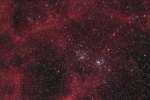 Double Cluster in Perseus
23.01.2014
This lovely starfield spans some seven full moons (about 3.5 degrees) across the heroic northern constellation of Perseus. Just right of center it holds the famous pair of open or galactic star clusters, h and Chi Perseii.
 APOD: 2023 April 2 Б M57: The Ring Nebula from Hubble
2.04.2023
It was noticed hundreds of years ago by stargazers who could not understand its unusual shape. It looked like a ring on the sky. Except for the rings of Saturn, the Ring Nebula (M57) may be the most famous celestial circle.
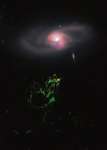 Hanny s Voorwerp
10.02.2011
Hanny's Voorwerp, Dutch for "Hanny's Object", is enormous, about the size of our own Milky Way Galaxy. Glowing strongly in the greenish light produced by ionized oxygen atoms, the mysterious voorwerp is below spiral galaxy IC 2497 in this view from the Hubble Space Telescope.
|
January February March April May June July August |
||||||||||||||||||||||||||||||||||||||||||||||||||||||||