
|
You entered: ionization
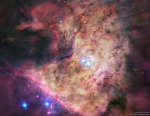 Trapezium: At the Heart of Orion
5.08.2018
Near the center of this sharp cosmic portrait, at the heart of the Orion Nebula, are four hot, massive stars known as the Trapezium. Gathered within a region about 1.5 light-years in radius, they dominate the core of the dense Orion Nebula Star Cluster.
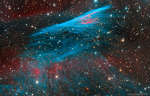 The Pencil Nebula in Red and Blue
13.08.2018
This shock wave plows through interstellar space at over 500,000 kilometers per hour. Near the top and moving up in this sharply detailed color composite, thin, bright, braided filaments are actually long ripples in a cosmic sheet of glowing gas seen almost edge-on.
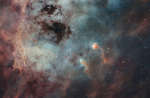 APOD: 2026 March 17 Б The Tadpoles of IC 410
17.03.2026
This telescopic close-up shows off the central regions of otherwise faint emission nebula IC 410, captured under backyard skies. Presented in a Hubble color palette, the image combines visible broadband and narrowband data with data from the near-infrared. Below and right of center are two remarkable inhabitants of the interstellar pond of gas and dust.
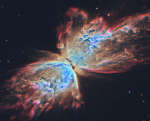 The Butterfly Nebula from Hubble
1.10.2014
The bright clusters and nebulae of planet Earth's night sky are often named for flowers or insects. Though its wingspan covers over 3 light-years, NGC 6302 is no exception. With an estimated surface...
 The Orion Bullets
10.01.2013
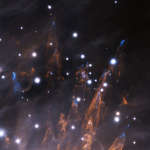
Cosmic bullets pierce the outskirts of the Orion Nebula some 1500 light-years distant in this sharp infrared close-up. Blasted out by energetic massive star formation the bullets, relatively dense, hot gas clouds about ten times the size of Pluto's orbit, are blue in the false color image.
 Shell Game in NGC 300
22.08.2002
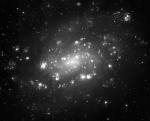
Featured in color in yesterday's episode, big, beautiful, face-on spiral galaxy NGC 300 is seen here through a narrow filter that transmits only the red light of hydrogen atoms. Ionized by energetic starlight, a hydrogen atom emits the characteristic red H-alpha light as its single electron is recaptured and transitions to lower energy states.
 Bright Star Knots in NGC 4038
2.06.1997
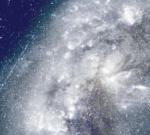
This galaxy is having a bad millennium. In fact, the past 100 million years haven't been so good, and probably the next billion or so should be quite tumultuous. NGC 4039 was a normal spiral galaxy, minding its own business, when NGC 4038 crashed into it.
 Comet over California
7.03.2008
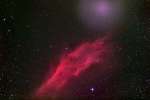
Still gracing northern skies, a fading Comet Holmes lies at the top edge of this colorful skyview, recorded on March 4. The reddish emission nebula below it is NGC 1499, also known as the California Nebula for its resemblance to the outline of the state on the US west coast.
 The Necklace Nebula
3.11.2010
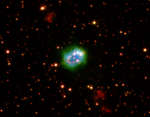
The small constellation Sagitta sports this large piece of cosmic jewelry, dubbed the Necklace Nebula. The newly discovered example of a ring-shaped planetary nebula is about 15,000 light-years distant. Its bright ring with pearls of glowing gas is half a light-year across.
 A Giant Squid in the Flying Bat
27.10.2016
Very faint but also very large on planet Earth's sky, a giant Squid Nebula cataloged as Ou4, and Sh2-129 also known as the Flying Bat Nebula, are both caught in this cosmic scene toward the royal constellation Cepheus.
|
January February March April May June July August |
||||||||||||||||||||||||||||||||||||||||||||||||||||||||