
|
You entered: ionization
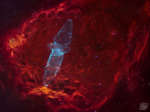 Ou4: A Giant Squid in a Flying Bat
7.10.2020
A very faint but very large squid-like nebula is visible in planet Earth's sky -- but inside a still larger bat. The Giant Squid Nebula cataloged as Ou4, and Sh2-129 also known as the Flying Bat Nebula, are both caught in this cosmic scene toward the royal royal constellation Cepheus.
 M51 in 255 Hours
11.08.2023
An intriguing pair of interacting galaxies, M51 is the 51st entry in Charles Messier's famous catalog. Perhaps the original spiral nebula, the large galaxy with whirlpool-like spiral structure seen nearly face-on is also cataloged as NGC 5194. Its spiral arms and dust lanes sweep in front of a companion galaxy (right), NGC 5195.
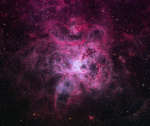 The Tarantula Nebula
17.11.2018
The Tarantula Nebula, also known as 30 Doradus, is more than a thousand light-years in diameter, a giant star forming region within nearby satellite galaxy the Large Magellanic Cloud. About 180 thousand light-years away, it's the largest, most violent star forming region known in the whole Local Group of galaxies.
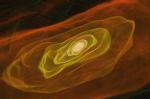 Zooming in on the First Stars
10.06.2003
What became of the first stars? No known stars appear to be composed of truly primordial gas -- all of the stars around us have too many heavy elements. Our own Sun is thought to be a third generation star, with many second-generation stars seen in globular clusters.
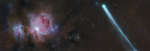 APOD: 2026 May 12 Б The Conjunction of Comet R3 PanSTARRS and the Orion Nebula
12.05.2026
TodayБs composite image features something old, something new, something borrowed, and something blue! Comet R3 PanSTARRS, streaking across the right of the image, likely originated from the Oort Cloud, meaning it is an old Solar System relic from billions of years ago.
 Pickering s Triangle in the Veil
17.09.2015
Chaotic in appearance, these filaments of shocked, glowing gas break across planet Earth's sky toward the constellation of Cygnus, as part of the Veil Nebula. The Veil Nebula itself is a large supernova remnant, an expanding cloud born of the death explosion of a massive star.
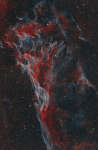 Williamina Fleming s Triangular Wisp
10.11.2017
Chaotic in appearance, these tangled filaments of shocked, glowing gas are spread across planet Earth's sky toward the constellation of Cygnus as part of the Veil Nebula. The Veil Nebula itself is a large supernova remnant, an expanding cloud born of the death explosion of a massive star.
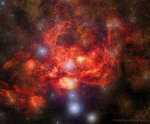 NGC 6357: The Lobster Nebula
1.11.2022
Why is the Lobster Nebula forming some of the most massive stars known? No one is yet sure. Cataloged as NGC 6357, the Lobster Nebula houses the open star cluster Pismis 24 near its center -- a home to unusually bright and massive stars.
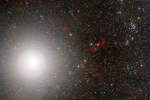 In the Glare of Alpha Centauri
28.06.2012
The glare of Alpha Centauri, one of the brightest stars in planet Earth's night sky, floods the left side of this southern skyscape. A mere 4.3 light-years distant, Alpha Centauri actually consists of two component stars similar in size to the Sun, locked in a mutual orbit.
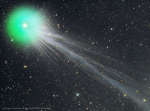 The Complex Ion Tail of Comet Lovejoy
20.01.2015
What causes the structure in Comet Lovejoy's tail? Comet C/2014 Q2 (Lovejoy), which is currently at naked-eye brightness and near its brightest, has been showing an exquisitely detailed ion tail. As the name...
|
January February March April May June July August |
||||||||||||||||||||||||||||||||||||||||||||||||||||||||