
|
You entered: clouds
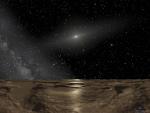 Sedna at Noon
4.06.2004
Standing on Sedna - the solar system's most distant known planetoid - your view of the Sun at high noon might look something like this. An artist's dramatic vision, the picture shows the Sun suspended above the nearby horizon as a bright star immersed in the dusty ecliptic plane.
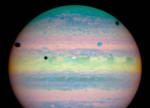 Pastel Planet, Triple Eclipse
11.11.2004
This false-color image of banded gas giant Jupiter shows a triple eclipse in progress on March 28 - a relatively rare event, even for a large planet with many moons. Captured by the Hubble Space...
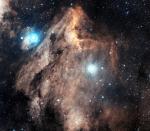 A Pelican in the Swan
30.11.2006
The Pelican Nebula lies about 2,000 light-years away in the high flying constellation Cygnus, the Swan. Also known as IC 5070, this cosmic pelican is appropriately found just off the "east coast" of the North America Nebula (NGC 7000), another surprisingly familiar looking emission nebula in Cygnus.
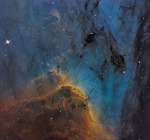 Pelican Nebula Close Up
26.11.2011
The prominent ridge of emission featured in this vivid skyscape is designated IC 5067. Part of a larger emission nebula with a distinctive shape, popularly called The Pelican Nebula, the ridge spans about 10 light-years and follows the curve of the cosmic pelican's head and neck.
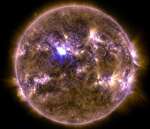 Sun with Solar Flare
13.04.2013
This week the Sun gave up its strongest solar flare so far in 2013, accompanied by a coronal mass ejection (CME) headed toward planet Earth. A false-color composite image in extreme ultraviolet light from the Solar Dynamics Observatory captures the moment, recorded on April 11 at 0711 UTC. The flash, a moderate, M6.
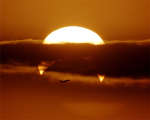 Partial Solar Eclipse with Airplane
13.05.2013
It was just eight minutes after sunrise, last week, and already there were four things in front of the Sun. The largest and most notable was Earth's Moon, obscuring a big chunk of the Sun's lower limb as it moved across the solar disk, as viewed from Fremantle, Australia.
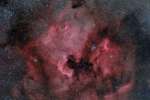 North America and the Pelican
3.09.2013
Here lie familiar shapes in unfamiliar locations. On the left is an emission nebula cataloged as NGC 7000, famous partly because it resembles our fair planet's continent of North America. The emission region to the right of the North America Nebula is IC 5070, also known for its suggestive outlines as the Pelican Nebula.
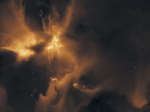 A Particle Beam Jet forms HH 24
4.02.2014
If you visit HH 24, don't go near the particle beam jet. This potential future travel advisory might be issued because the powerful jet likely contains electrons and protons moving hundreds of kilometers per second.
 NGC 7331 and Beyond
1.03.2014
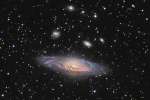
Big, beautiful spiral galaxy NGC 7331 is often touted as an analog to our own Milky Way. About 50 million light-years distant in the northern constellation Pegasus, NGC 7331 was recognized early on as a spiral nebula and is actually one of the brighter galaxies not included in Charles Messier's famous 18th century catalog.
 Eclipsed in Southern Skies
1.10.2015
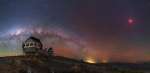
This stunning panorama in southern skies was recorded on the colorful night of September 27/28 from Carngegie Las Campanas Observatory. A diffuse glow and dark rifts of the central Milky Way hang over domes of the twin 6.5 meter Magellan telescopes. But most eye-catching is the deep red glow of the Moon.
|
January February March April May June July August September October |
|||||||||||||||||||||||||||||||||||||||||||||||||