
|
You entered: clouds
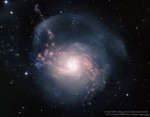 NGC 3310: A Starburst Spiral Galaxy
1.03.2016
The party is still going on in spiral galaxy NGC 3310. Roughly 100 million years ago, NGC 3310 likely collided with a smaller galaxy causing the large spiral galaxy to light up with a tremendous burst of star formation.
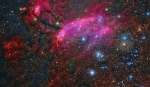 IC 4628: The Prawn Nebula
9.12.2016
South of Antares, in the tail of the nebula-rich constellation Scorpius, lies emission nebula IC 4628. Nearby hot, massive stars, millions of years young, irradiate the nebula with invisible ultraviolet light, stripping electrons from atoms. The electrons eventually recombine with the atoms to produce the visible nebular glow, dominated by the red emission of hydrogen.
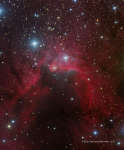 SH2-155: The Cave Nebula
23.03.2017
This skyscape features dusty Sharpless catalog emission region Sh2-155, the Cave Nebula. In the telescopic image, data taken through a narrowband filter tracks the reddish glow of ionized hydrogen atoms. About 2,400 light-years away, the scene lies along the plane of our Milky Way Galaxy toward the royal northern constellation of Cepheus.
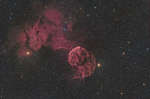 Sharpless 249 and the Jellyfish Nebula
23.03.2018
Normally faint and elusive, the Jellyfish Nebula is caught in this alluring telescopic image. Centered in the scene it's anchored right and left by two bright stars, Mu and Eta Geminorum, at the foot of the celestial twin. The Jellyfish Nebula is the brighter arcing ridge of emission with dangling tentacles.
 The Witch Head Nebula
31.12.2018
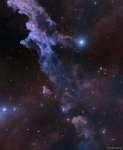
Double, double toil and trouble; Fire burn, and cauldron bubble .... maybe Macbeth should have consulted the Witch Head Nebula. A frighteningly shaped reflection nebula, this cosmic crone is about 800 light-years away though. Its malevolent visage seems to glare toward nearby bright star Rigel in Orion, just off the right edge of this frame.
 Orion and the Running Man
10.03.2023
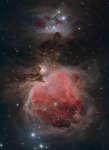
Few cosmic vistas excite the imagination like The Great Nebula in Orion. Visible as a faint celestial smudge to the naked-eye, the nearest large star-forming region sprawls across this sharp telescopic image, recorded on a cold January night in dark skies from West Virginia, planet Earth.
 APOD: 2024 September 29 Б Seven Dusty Sisters
29.09.2024
Is this really the famous Pleiades star cluster? Known for its iconic blue stars, the Pleiades is shown here in infrared light where the surrounding dust outshines the stars. Here, three infrared colors have been mapped into visual colors (R=24, G=12, B=4.6 microns).
 APOD: 2024 October 29 Б NGC 602: Stars Versus Pillars from Webb
29.10.2024
The stars are destroying the pillars. More specifically, some of the newly formed stars in the image center are emitting light so energetic that is evaporating the gas and dust in the surrounding pillars. Simultaneously, the pillars themselves are still trying to form new stars.
 APOD: 2026 January 27 Б Orions Treasures over Snowy Mountains
27.01.2026
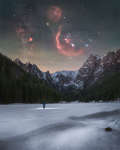
Rising over a frozen valley in the Tatra Mountains, the familiar stars and nebulas of Orion dominate this wide-field nightscape. The featured deep photo was taken in southern Poland's highest mountain range last month, where dark skies and alpine terrain combined to reveal both Earth's rugged beauty and the structure of our galaxy.
 Saturnian Aurora
23.12.2001
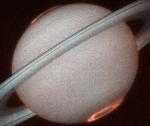
the second largest planet in the Solar System, Saturn's Rings are one of the most spectacular sights for earthbound telescopes. This image from the orbiting Hubble Space Telescope's STIS instrument, offers a striking view of another kind of ring around Saturn - pole encircling rings of ultraviolet aurora.
|
January February March April May June July August September October |
|||||||||||||||||||||||||||||||||||||||||||||||||