
|
You entered: century
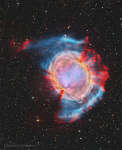 APOD: 2026 June 22 Б M27: The Dumbbell Nebula
22.06.2026
Is this what will become of our Sun? Quite possibly. The first hint of our Sun's future was discovered inadvertently in 1764. At that time, Charles Messier was compiling a list of diffuse objects not to be confused with comets.
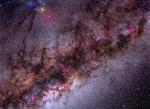 Our Galaxy in Stars, Gas, and Dust
27.09.1999
The disk of our Milky Way Galaxy is home to hot nebulae, cold dust, and billions of stars. The red nebulae visible in the above contrast-enhanced picture are primarily emission nebulae, glowing clouds of hydrogen gas heated by nearby, bright, young stars.
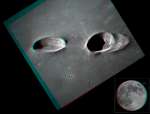 Messier Craters in Stereo
11.12.2009
Many bright nebulae and star clusters in planet Earth's sky are associated with the name of astronomer Charles Messier, from his famous 18th century catalog. His name is also given to these two large and remarkable craters on the Moon.
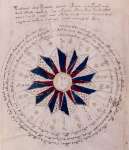 The Mysterious Voynich Manuscript
31.01.2010
The ancient text has no known title, no known author, and is written in no known language: what does it say and why does it have many astronomy illustrations? The mysterious book was once bought by an emperor, forgotten on a library shelf, sold for thousands of dollars, and later donated to Yale.
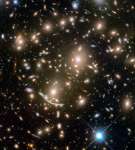 Galaxy Cluster Abell 370 and Beyond
6.05.2017
Some 4 billion light-years away, massive galaxy cluster Abell 370 only appears to be dominated by two giant elliptical galaxies and infested with faint arcs in this sharp Hubble Space Telescope snapshot. The fainter...
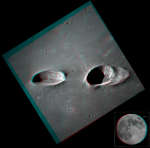 Messier Craters in Stereo
11.12.2020
Many bright nebulae and star clusters in planet Earth's sky are associated with the name of astronomer Charles Messier from his famous 18th century catalog. His name is also given to these two large and remarkable craters on the Moon.
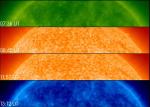 Mercury Spotting
6.06.2004
Can you spot the planet? The diminutive disk of Mercury, the solar system's innermost planet, spent about five hours crossing in front of the enormous solar disk on 2003 May 7, as viewed from the general vicinity of planet Earth.
 Messier Craters in Stereo
2.12.2017
Many bright nebulae and star clusters in planet Earth's sky are associated with the name of astronomer Charles Messier, from his famous 18th century catalog. His name is also given to these two large and remarkable craters on the Moon.
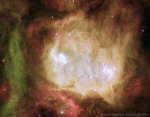 Halloween and the Ghost Head Nebula
24.10.2021
Halloween's origin is ancient and astronomical. Since the fifth century BC, Halloween has been celebrated as a cross-quarter day, a day halfway between an equinox (equal day / equal night) and a solstice (minimum day / maximum night in the northern hemisphere).
 Galaxy Cluster Abell 370 and Beyond
12.09.2023
Some 4 billion light-years away, massive galaxy cluster Abell 370 is captured in this sharp Hubble Space Telescope snapshot. The cluster of galaxies only appears to be dominated by two giant elliptical galaxies and infested with faint arcs.
|
January February March April May June July August September |
|||||||||||||||||||||||||||||||||||||||||||||||||