
|
You entered: century
 APOD: 2026 May 9 Б Messier Craters in Stereo
9.05.2026
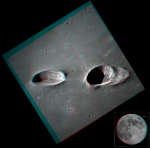
Many bright nebulae and star clusters in planet Earth's sky are associated with the name of astronomer Charles Messier from his famous 18th century catalog. His name is also given to these two large and remarkable craters on the Moon.
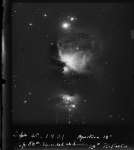 1901 Photograph: The Orion Nebula
17.08.2019
By the turn of the 20th century advances in photography contributed an important tool for astronomers. Improving photographic materials, long exposures, and new telescope designs produced astronomical images with details not visible at the telescopic eyepiece alone.
 Mercury Spotting
8.05.2003
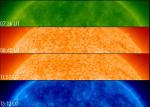
Can you spot the planet? The diminutive disk of Mercury, the solar system's innermost planet, spent about five hours crossing in front of the enormous solar disk yesterday (Wednesday, May 7th), as viewed from the general vicinity of planet Earth.
 Messier Marathon
11.03.2000
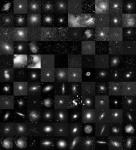
Gripped by an astronomical spring fever, it's once again time for many amateur stargazers to embark on a Messier Marathon! The Vernal Equinox occurs March 20, marking the first day of Spring for the Northern Hemisphere.
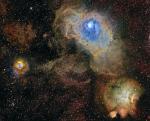 Three Nebulae in Narrow Band
2.11.2007
Narrow band filters and a false-color palette give these three nebulae a stunning appearance against the cosmic canvas of the central Milky Way. All three are stellar nurseries about 5,000 light-years or so distant, toward the nebula rich constellation Sagittarius.
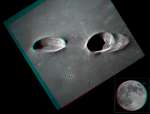 Messier Craters in Stereo
8.06.2013
Many bright nebulae and star clusters in planet Earth's sky are associated with the name of astronomer Charles Messier, from his famous 18th century catalog. His name is also given to these two large and remarkable craters on the Moon.
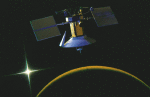 A World Explorer
25.08.1995
Ferdinand Magellan was a world explorer. Many consider him the greatest navigator of Europe's 16th century age of sea going exploration and credit his expedition with the first circumnavigation of planet Earth. NASA...
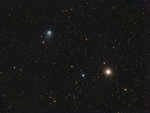 Comet Garradd and Messier 15
6.08.2011
Recorded on August 2, this telescopic composite image catches Comet Garradd (C/2009 P1) in the same field of view as globular star cluster M15. The celestial scene would have been a rewarding one for influential 18th century comet hunter Charles Messier.
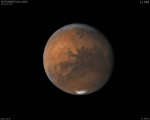 Solis Lacus: The Eye of Mars
1.10.2020
As telescopes around planet Earth watch, Mars is growing brighter in night skies, approaching its 2020 opposition on October 13. Mars looks like its watching too in this view of the Red Planet from September 22.
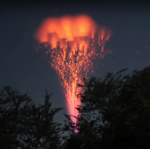 Gigantic Jet Lightning from Puerto Rico
29.09.2021
Have you ever seen a gigantic jet? They are extremely rare but tremendously powerful. Gigantic jets are a type of lightning discharge documented only this century that occur between some thunderstorms and the Earth's ionosphere high above them.
|
January February March April May June July August September |
|||||||||||||||||||||||||||||||||||||||||||||||||