
|
You entered: Sun
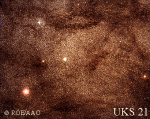 Lensing through Baade's Window
1.02.1996
What is the shape and composition of our Milky Way Galaxy? This question would be easier to answer if there wasn't so much obscuring dust! In the 1940s, however, astronomer Walter Baade identified a "window" near the center of our Galaxy where there is comparatively little opaque dust.
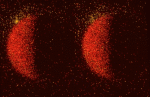 X-ray Moon and X-ray Star
27.02.1996
An X-ray star winks out behind the Moon in these before and after views of a lunar occultation of the galactic X-ray source designated GX5-1. The false color images were made using data...
 Contemplating Mars
2.09.2003
Is that really another world? Thousands of people the world over lined up last week to see Mars through a telescope as the red planet and Earth passed unusually close together in their orbits around the Sun. Reviews of Mars were mixed, with some people disappointed that Mars still appeared somewhat blurry.
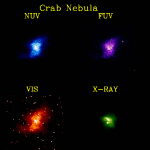 The High Energy Crab Nebula
22.11.1998
This is the mess that is left when a star explodes. The Crab Nebula is so energetic that it glows in every kind of light known. Shown above are images of the Crab Nebula from visible light to the X-ray band.
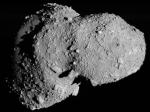 The Missing Craters of Asteroid Itokawa
21.11.2005
Where are the craters on asteroid Itokawa? No one knows. The Japanese robot probe Hayabusa recently approached the Earth-crossing asteroid and is returning pictures showing a surface unlike any other Solar System body yet photographed -- a surface possibly devoid of craters.
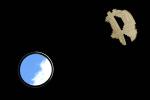 Pantheon Earth and Moon
20.04.2007
Could this be a picture of the Earth and Moon from space? It certainly looks like it at first glance, with a dark, cratered Moon standing off from planet Earth's lovely blue disk surrounded by a nurturing atmosphere. In fact, this view looks up into the dome of the ancient Pantheon in Rome.
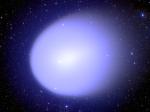 Expansive Comet Holmes
21.11.2007
The spherical coma of Comet Holmes has swollen to a diameter of over 1.4 million kilometers, making the tenuous, dusty cloud even bigger than the Sun. Scattering sunlight, all that dust and gas came...
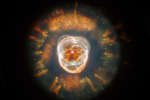 The Eskimo Nebula from Hubble
3.05.2009
In 1787, astronomer William Herschel discovered the Eskimo Nebula. From the ground, NGC 2392 resembles a person's head surrounded by a parka hood. In 2000, the Hubble Space Telescope imaged the Eskimo Nebula. From space, the nebula displays gas clouds so complex they are not fully understood.
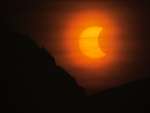 Solar Eclipse over Antarctica
2.12.2011
Last Friday, the fourth and final partial solar eclipse of 2011 was only visible from high latitudes in the southern hemisphere. If you missed it, check out this dramatic picture of the geocentric celestial event from a very high southern latitude on the continent of Antarctica.
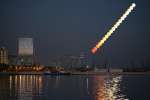 Baku Moonrise
8.12.2012
A Full Moon rises in this waterfront scene. Its colorful, watery reflection is joined by harbor lights and a windowed skyscraper's echo of the western horizon just after sunset. The tantalizing image is a composite of frames recorded at 2 minute intervals on November 28 from the Caspian Sea port city of Baku, Azerbaijan.
|
January February March April May June July August September October |
|||||||||||||||||||||||||||||||||||||||||||||||||