
|
You entered: Sun
 APOD: 2024 November 12 Б NGC 6888: The Crescent Nebula
12.11.2024
How was the Crescent Nebula created? Looking like an emerging space cocoon, the Crescent Nebula, visible in the center of the featured image, was created by the brightest star in its center. A leading progenitor hypothesis has the Crescent Nebula beginning to form about 250,000 years ago.
 Orion and the Running Man
13.11.2025
Few cosmic vistas can excite the imagination like The Great Nebula in Orion. Visible as a faint, bland celestial smudge to the naked-eye, the nearest large star-forming region sprawls across this sharp colorful telescopic image. Designated M42 in the Messier Catalog, the Orion Nebula's glowing gas and dust surrounds hot, young stars.
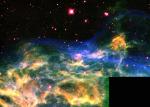 At the Edge of the Crescent Nebula
2.08.2000
The Crescent Nebula is a rapidly expanding shell of gas surrounding a dying star. In this recently released image by the Hubble Space Telescope, a bright dynamic part of the nebula three light-years across is shown in representative color.
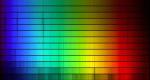 Stellar Spectral Types: OBAFGKM
30.05.2001
Astronomers divide stars into different spectral types. First started in the 1800s, the spectral type was originally meant to classify the strength of hydrogen absorption lines. A few types that best describe the temperature of the star remain in use today.
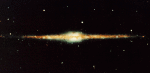 The Milky Way's Center
8.09.1995
NASA's COBE satellite scanned the heavens at infrared wavelengths in 1990 and produced this premier view of the central region of our own Milky Way Galaxy. The Milky Way is a typical spiral galaxy with a central bulge and extended disk of stars.
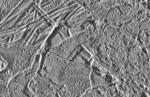 Europa: The Latest From Galileo
17.01.1997
Today, NASA revealed recent results from the Galileo Probe's December 19th flyby of Europa, Jupiter's ice-covered moon - including this close-up image of fractured and frozen terrrain. The highest resolution picture ever made...
 Hyakutake: Comet Atmosphere
10.04.1998
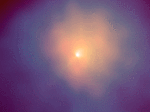
The atmosphere of a comet comes and goes. Approaching the sun, it swells as material from the icy cometary nucleus is warmed and evaporated by increasing sunlight. Immense but tenuous and fleeting, the inner atmosphere or inner "coma" of comet Hyakutake is seen in this false color picture.
 Reflecting Merope
4.12.2004
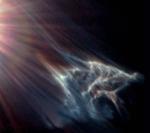
In the well known Pleiades star cluster, a star's light is slowly destroying this wandering cloud of gas and dust. Above, the star Merope lies just off the upper left edge of this picture from the Hubble Space Telescope.
 NGC 246 and the Dying Star
18.04.2006
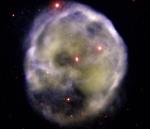
Appropriately nicknamed "the Skull Nebula", planetary nebula NGC 246 really does surround a dying star some 1,600 light-years away in the constellation Cetus. Expelled over a period of thousands of years, the lovely, intricate nebula is the outer atmosphere of a once sun-like star.
 J1502 1115: A Triple Black Hole Galaxy
7.07.2014
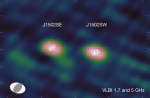
Most galaxies contain one supermassive black hole -- why does this galaxy have three? The likely reason is that galaxy J1502+1115 is the product of the recent coalescence of three smaller galaxies.
|
January February March April May June July August September October |
|||||||||||||||||||||||||||||||||||||||||||||||||