
|
You entered: Sun
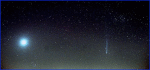 Comet Hyakutake on a Starry Night
23.04.1996
It was a starry night in April (April 9th, 1996, 9:32 pm CDT to be exact) near Lone Jack, Missouri when Comet Hyakutake graced this astronomically rich field. Making an appearance as the brilliant evening star, Venus is overexposed at the far left.
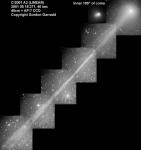 LINEAR s Tail and Two Nuclei
31.05.2001
Arcing toward southern skies in late March, this faint comet LINEAR - the one officially designated C/2001 A2 (LINEAR) - brightened unexpectedly. The outburst, apparently due to the fragmentation of its nucleus, delighted observers as the comet eventually increased to naked-eye brightness.
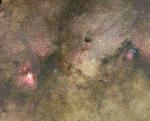 APOD: 2002 September 18- A Sagittarius Starscape
18.09.2002
Many vast star fields in the plane of our Milky Way Galaxy are rich in clouds of stars, dust, and gas. First and foremost, visible in the above picture are millions of stars, many of which are similar to our Sun.
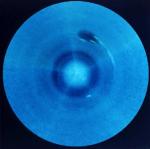 Southern Neptune
29.05.1997
Neptune, the Solar System's outermost gas giant planet, is 30 times farther from the Sun than Earth. Twelve years after a 1977 launch, Voyager 2 flew by Neptune and found surprising activity on a planet that receives only 3 percent as much sunlight as Jupiter.
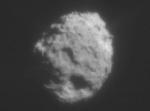 Comet Wild 2s Nucleus from Stardust
3.01.2004
What does a comet nucleus look like? Yesterday the robot spacecraft Stardust answered this question by returning the most detailed images yet of the center of a comet. The icy centers of comets are usually hidden from Earth-bound telescopes by opaque dust and gas that boils off during approach to the Sun.
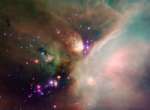 Young Stars in the Rho Ophiuchi Cloud
15.02.2008
Cosmic dust clouds and embedded newborn stars glow at infrared wavelengths in this tantalizing false-color view from the Spitzer Space Telescope. Pictured is of one of the closest star forming regions, part of the Rho Ophiuchi cloud complex some 400 light-years distant near the southern edge of the pronounceable constellation Ophiuchus.
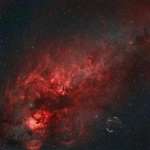 Nebulae in the Northern Cross
19.11.2010
Explore a beautiful and complex region of nebulae strewn along the plane of our Milky Way Galaxy in this widefield skyscape. The image emphasizes cosmic gas clouds in a 25 by 25 degree view centered on the Northern Cross, the famous asterism in the constellation Cygnus.
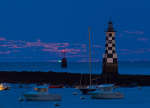 Green Flash and Super Moon
10.05.2012
It was really not about superheroes as on May 6 the much touted Super Moon, the largest Full Moon of 2012, rose over this otherwise peaceful harbor. And no supervillains were present either as boats gently rocked at their moorings near the checkerboard La Perdrix lighthouse on the coast of Brittany, France.
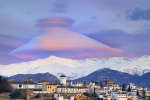 Cap Cloud over the Sierra Nevadas
26.11.2013
One might say this was a bell weather day for the Sierra Nevada mountains. In January, just as the Sun was setting above the district of AlbayzМn in Grenada, Spain, a huge cloud appeared as a bell capping the Veleta peak.
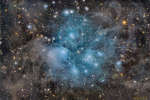 The Pleiades Deep and Dusty
25.02.2014
The well known Pleiades star cluster is slowly destroying part of a passing cloud of gas and dust. The Pleiades is the brightest open cluster of stars on Earth's sky and can be seen from almost any northerly location with the unaided eye.
|
January February March April May June July August September October |
|||||||||||||||||||||||||||||||||||||||||||||||||