
|
You entered: Sun
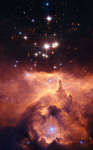 Massive Stars in Open Cluster Pismis 24
26.10.2008
How massive can a normal star be? Estimates made from distance, brightness and standard solar models had given one star in the open cluster Pismis 24 over 200 times the mass of our Sun, making it a record holder. This star is the brightest object located just above the gas front in the above image.
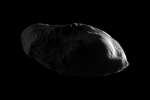 Prometheus Remastered
5.04.2010
What does Saturn's shepherd moon Prometheus really look like? The raw images from the robotic Cassini spacecraft's January flyby of the small moon showed tantalizing clues on grainy images, but now that the Cassini team has digitally remastered these images, many more details have come out.
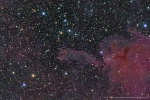 Cometary Globule CG4
5.03.2015
The faint and somehow menacing cometary globule CG4 reaches through the center of this deep southern skyscape. About 1,300 light-years from Earth toward the constellation Puppis, its head is about 1.5 light-years in diameter and its tail about 8 light-years long.
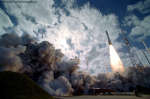 APOD: 2015 July 12 New Horizons Launch to Pluto
12.07.2015
Destination: Pluto. The New Horizons spacecraft roared off its launch pad at Cape Canaveral in Florida, USA in 2006 toward adventures in the distant Solar System. The craft is the fastest spaceships ever launched by humans, having passed the Moon only nine hours after launch, and Jupiter only a year later.
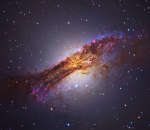 Centaurus A
19.11.2015
What's the closest active galaxy to planet Earth? That would be Centaurus A, only 11 million light-years distant. Spanning over 60,000 light-years, the peculiar elliptical galaxy is also known as NGC 5128.
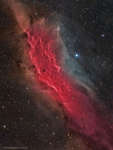 The California Nebula
12.01.2016
What's California doing in space? Drifting through the Orion Arm of the spiral Milky Way Galaxy, this cosmic cloud by chance echoes the outline of California on the west coast of the United States.
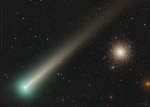 Comet Leonard Before Star Cluster M3
12.12.2021
Comet Leonard is now visible to the unaided eye -- but just barely. Passing nearest to the Earth today, the comet is best seen this week soon after sunset, toward the west, low on the horizon.
 APOD: 2023 August 15 Б A Triply Glowing Night Sky over Iceland
15.08.2023
The Sun is not the quiet place it seems. It expels an unsteady stream of energetic electrons and protons known as the solar wind. These charged particles deform the Earth's magnetosphere, change paths...
 APOD: 2025 May 13 Б Gaia Reconstructs a Top View of our Galaxy
13.05.2025
What does our Milky Way Galaxy look like from the top? Because we are on the inside, humanity canБt get an actual picture. Recently, however, just such a map has been made using location data for over a billion stars from ESAБs Gaia mission.
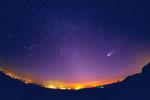 Sirius: The Brightest Star in the Night
11.06.2000
Sirius is the brightest star in the night sky. Sirius is visible on the far left of the above photograph, to the left of the constellation of Orion and Comet Hale-Bopp. Intrinsically, Sirius is over 20 times brighter than our Sun and over twice as massive.
|
January February March April May June July August September October |
|||||||||||||||||||||||||||||||||||||||||||||||||